

For a supplement that needs a defined compound content, or a formula with limited room for ginger, we generally recommend evaluating a standardized ginger extract. For a drink, we start with a grade designed for use in water. Those are situations where an extract can offer a practical advantage over ordinary ginger powder.
For a spice blend or a recipe built around the full character of ground ginger, powder may already be the right ingredient. Our answer comes down to what you need ginger to do in the finished product.Let's walk through the difference, the numbers behind it, and how we would choose a sample for your project.
When an extract makes a practical difference
1. What changes when ginger is extracted
Ordinary ginger powder is made by drying and grinding the rhizome, the underground stem commonly called ginger root. Grinding makes the particles smaller; it does not, by itself, selectively concentrate ginger's compounds.An extract goes through an additional separation step. Selected constituents are removed from the plant material, then processed into the required ingredient. A finished extract powder may also contain carriers or other formulation ingredients. We therefore check both its measured content and its complete composition.
Extraction and standardization also mean different things. Extraction describes how the material is obtained. Standardization means the ingredient is made to meet a defined content specification. An extract is not automatically standardized just because "extract" appears in its name.
2. What laboratory measurements actually show
We use gingerols and shogaols, groups of pungent ginger compounds, as useful measurement targets. In a 2019 study, You and colleagues used high-performance liquid chromatography, or HPLC, to analyze ginger ingredients. Their reported mean results included the following two samples. [1]
| Measured compound | Ginger rhizome powder | Ginger dry extract |
|---|---|---|
| 6-Gingerol | 0.554% | 2.969% |
| 6-Shogaol | 0.116% | 0.505% |
The study's precision assessment used 12 replicate preparations per material across three days. For these particular samples, the dry extract contained about 5.4 times as much 6-gingerol per gram as the powder. These were separate materials, not a before-and-after test of the same ginger batch. [1]
These independent results illustrate concentration. For our own products, we use the selected batch's measured content to calculate inclusion levels. Health claims need evidence for the relevant preparation and use.For purchasing, the advantage is having a content specification you can calculate with and verify. If your formula needs a particular quantity of those compounds, a suitable extract can deliver it with less ingredient weight.
Choosing the right ginger extract grade
1. Start with water performance for drinks
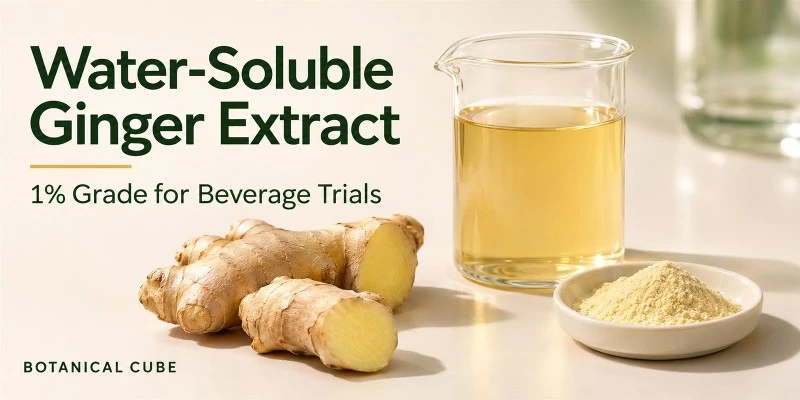
Our Botanical Cube range includes Water-Soluble 1% and standard 5%, 10% and 20% grades. For a ginger shot, drink or instant beverage, we recommend starting with the water-soluble 1% grade. Our standard grades are not water-soluble alternatives. [2] The first decision is whether the ingredient behaves as your drink requires. A high percentage is of little help if the finished bottle develops unacceptable particles or sediment.
We also consider the total ingredient declaration. A grade formulated for water use may include a carrier or emulsifier, which matters if your brand has restrictions on those ingredients. Water performance, taste and composition belong in the same sample review.A 1% grade is not automatically less suitable than a 10% grade. It serves a different formulation need. We would judge it in the actual drink, at the proposed concentration and under your processing conditions.
2. Use your available formula space to compare standard grades
For a capsule or tablet, we start with two numbers: the target amount of measured compounds and the ingredient mass the formula can accommodate.Here is a calculation example, not a dosage recommendation or a customer trial. Suppose the target is 10 mg of the same defined compound group per serving. Assuming comparable assays and no processing loss:
| Extract assay | Ingredient needed | What this means for formulation |
|---|---|---|
| 5% | 200 mg per serving | A candidate when the formula can accommodate this ingredient mass |
| 10% | 100 mg per serving | Worth comparing when 200 mg would exceed the available allowance |
| 20% | 50 mg per serving | Worth evaluating when further mass reduction solves a real constraint |
Now imagine you have allocated only 150 mg of ingredient mass to ginger. On this calculation, the 5% grade exceeds that allowance, while the 10% and 20% grades stay within it. That gives us a clear reason to compare higher grades.
If the 10% sample already meets the target, fits the formula and performs well, we would assess whether the 20% option offers any additional value. Higher concentration alone is not a reason to pay more. Actual capsule fit still needs confirmation because bulk density and the rest of the blend affect filling.
3. Confirm what the percentage includes
We compare assays, meaning laboratory measurements of content, on the same basis. "6-gingerol," "total gingerols" and "gingerols plus shogaols" are different specifications. A 10:1 extraction ratio also does not establish the measured percentage in the finished powder.Our published supplier COAs provide these batch examples. Their reported totals combine specified gingerols and shogaols. [2]
| Grade | Example batch | Reported HPLC total |
|---|---|---|
| 1% | BCI20251015SJ1 | 1.13% |
| 5% | BCI20251215SJ5 | 5.08% |
| 10% | BCI20260120SJ10 | 10.08% |
In the 10% example, the listed gingerols total 8.83% and shogaols total 1.25%. Together they give 10.08%. Ask us for the current batch COA and assay definition so your calculation uses the correct figures. These historical results apply to the named lots. [2]
Checking the sample in your actual product
1. Compare against the result you want
We suggest setting the acceptance criteria before testing. For a beverage, that could mean an agreed ginger flavor, acceptable color and no unacceptable settling. For a capsule, it could mean meeting the content target while achieving consistent filling.If compound content is the objective, compare ingredients at the same defined compound target. If flavor is the objective, compare the amounts needed to achieve the desired taste. Equal weights of different ingredients do not necessarily make a useful comparison.
For a beverage screen, prepare the base recipe without ginger, the current version, and a version with the candidate extract. Keep the other ingredients, mixing procedure and packaging consistent. Record the ingredient amount, pH, temperature, taste and visible sediment.We suggest initial observations immediately after mixing, at 24 hours and at seven days under defined storage conditions. These checkpoints help identify early problems. They do not establish the product's shelf life, which needs a stability program suited to its intended storage and packaging.
2. Test after the processing step that matters
For a heated drink, check the processed drink. For a baked product, evaluate it after baking. For a capsule, run a filling trial with the intended blend.
Laboratory research comparing dry and moist heating found that gingerol-to-shogaol conversion depended on temperature, duration, heating type and the material tested. We take this as a reason to evaluate your actual process rather than assume the starting composition stays unchanged. [3]
A useful sample report should leave us with a decision: proceed, adjust the inclusion level, try another grade, or investigate a specific processing issue. Photos help document appearance; they do not replace a content assay or microbiological testing.
Comparing the cost of a finished batch
1. A higher kilogram price can still mean a lower ingredient cost
We carry the inclusion levels from the earlier example into a batch calculation. For 10,000 servings, the 5% ingredient would require 2.0 kg, while the 10% ingredient would require 1.0 kg to provide the same defined compound target.Assume hypothetical prices of $40/kg for the 5% grade and $65/kg for the 10% grade. These figures illustrate the calculation; they are not our quotations or current market prices.
| Option | Ingredient required | Ingredient cost for 10,000 servings |
|---|---|---|
| 5% at $40/kg | 2.0 kg | $80 |
| 10% at $65/kg | 1.0 kg | $65 |
The 10% option costs more per kilogram, but the calculated ingredient spend is $15 lower, a reduction of 18.75%. This comparison becomes useful commercially only when both options meet the same formulation requirements.
2. Include the costs your production team will actually incur
We then add relevant freight, testing, processing losses and handling costs. A change of ingredient may also require new formulation trials or stability work. Minimum order quantities matter if a seemingly attractive price leaves you with more stock than you can use.
To compare ordinary ginger powder on compound cost, we need its actual assay. For a flavor-led product, we use the tested inclusion level instead. We would not assign all ginger powders an assumed percentage.For a drink, acceptable water performance may be worth more than the lowest cost per milligram of measured compounds. The useful comparison is the cost of making an acceptable finished product.
Confirming quality and supply before a bulk order
1. Give the approved sample a clear purchasing specification
Once the sample works, we recommend recording its composition, assay basis, relevant physical properties and acceptance criteria. The quotation and bulk order should refer to that same specification.
This matters in an established, active ginger market. CBI's October 2025 report estimated that Europe imported 18,000 tonnes of dried ginger from developing countries in 2024, including 12,000 tonnes of crushed or powdered ginger. It described stable demand and buyer interest in reliable, longer-term supply relationships. These are dried-ginger figures, not extract sales. Our practical takeaway is to discuss repeatability and supply terms alongside price. [4] At Botanical Cube, we can discuss the selected grade's process, including supercritical CO₂ extraction, and the available composition and quality documents. [2]
2. Check the documents that support your intended use
We recommend reviewing the batch COA, test methods and relevant contaminant reports with your quality team. The scope may include pesticides, ethylene oxide, polycyclic aromatic hydrocarbons, heavy metals and microbiological quality, depending on the product and destination market.
For US dietary supplement manufacturing, FDA guidance explains the requirement for supplier qualification and confirmation of COA reliability when manufacturers rely on supplier COAs for eligible specifications. Dietary ingredient identity testing has separate requirements. A COA therefore supports a qualification process; it does not complete that process by itself. [5]
We also agree on packaging, lead time, storage conditions, remaining shelf life at delivery and notification of material changes. These details help connect a successful sample with a repeatable purchase.

Request Ginger Extract Samples and Specifications
We recommend evaluating ginger extract when you need a defined compound content, less ingredient mass, or a formulation developed for beverage use. The best starting sample follows from that requirement.
If you are working on a drink, tell us how it will be processed and whether clarity, sediment or ginger intensity is the main concern. For a capsule or tablet, share your target content and available formula space. You do not need to have selected a percentage before contacting us.
Our team can discuss available specifications, samples, batch documentation and bulk quotations. For a custom project, we can also review formulation requirements and OEM/ODM or private-label options for your brand.
Email sales@botanicalcube.com with your product format, target market, estimated quantity and the issue you want to solve. We can then identify suitable grades to evaluate and discuss the information your team needs for the next decision.
View our ginger extract range.
References
[1] You H, et al. Determination of bioactive nonvolatile ginger constituents in dietary supplements by a rapid and economic HPLC method: Analytical method development and single-laboratory validation. Talanta. 2019;194:795–802. See Tables 1 and 5 and Section 2.6.6. https://doi.org/10.1016/j.talanta.2018.10.075.
[2] Botanical Cube Inc. Ginger Extract. Grade information and supplier-issued COA examples for BCI20251015SJ1, BCI20251215SJ5 and BCI20260120SJ10. Accessed November 3, 2026. View product information.
[3] Jung MY, et al. Heat-induced conversion of gingerols to shogaols in ginger as affected by heat type (dry or moist heat), sample type (fresh or dried), temperature and time. Food Science and Biotechnology. 2018;27:687–693. https://doi.org/10.1007/s10068-017-0301-1.
[4] CBI. The European market potential for dried ginger. Updated October 16, 2025. The figures concern dried ginger imports, not the ginger extract market. Read the report.
[5] US Food and Drug Administration. Small Entity Compliance Guide: Current Good Manufacturing Practice in Manufacturing, Packaging, Labeling, or Holding Operations for Dietary Supplements. December 2010. See the component testing and supplier qualification provisions. Read FDA guidance.