


In the rapidly evolving world of longevity science, Nicotinamide Mononucleotide (NMN) has emerged as a titan. As someone deeply embedded in the botanical extract industry at Botanical Cube Inc., I have seen the global NMN market explode. Current market analysis suggests the global NAD+ supplement market was valued at approximately $530 million in 2023 and is projected to grow at a compound annual growth rate (CAGR) of over 14% through 2030 [1].
However, with great popularity comes a common misconception: that NMN is a "magic pill" suitable for everyone at any age.In our daily discussions with business clients and health-conscious professionals, we frequently encounter the idea that taking more NMN automatically leads to better results.
In reality, supplementation is not that simple.What we want to emphasize today is a more rational approach - moving away from blind supplementation and toward Precision Longevity, where NMN is used based on individual needs, safety considerations, and scientific understanding.

Why Do We Take NMN Anyway?
To understand who shouldn't take it, we must first understand what it does. NMN is a direct precursor to NAD+ (Nicotinamide Adenine Dinucleotide), a coenzyme found in every living cell.
Think of NAD+ as the "fuel" for your cellular maintenance crew. It drives:
- ATP Production: Turning food into energy in the mitochondria.
- DNA Repair: Activating sirtuins (the "longevity genes") that fix broken genetic code.
- Circadian Rhythm: Helping your body know when to sleep and when to wake.
- The logic of supplementation is simple: Our NAD+ levels drop by about 50% every 20 years after we hit our 20s [2]. We supplement to refill a leaking tank. But what if your tank is already full, or what if your body is currently fighting a battle where extra fuel might be counterproductive?

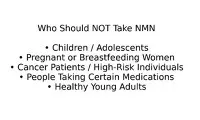
Who Should Not Take NMN?
While NMN is generally recognized as safe (GRAS) in many jurisdictions and has shown excellent safety profiles in human trials up to 1250mg/day [3], certain groups should exercise caution or avoid it entirely.
A. The Young and Healthy (Under 25-30)
If you are 20 years old, your NAD+ levels are likely at their biological peak. Supplementing NMN at this stage is like trying to pour water into a glass that is already 99% full.
- The Science: A 2021 study on amateur runners showed that while NMN enhanced aerobic capacity, the benefits were much more pronounced in older athletes compared to the youngest cohort [4]
- The Verdict: It isn't dangerous, but it is largely a waste of resources. Your body's natural feedback loops are highly efficient; don't disrupt them until they actually begin to slow down.
B. Pregnant and Breastfeeding Women
This is a standard medical precaution, but it is vital. Most clinical trials for NMN specifically exclude pregnant or lactating individuals.
- The Concern: We simply do not have long-term human data on how elevated NAD+ affects embryonic development or infant growth. In biology, "more" isn't always "better" for a developing fetus.
- The Verdict: Until rigorous safety trials are published, stay on the safe side and avoid NMN during this period.
C. Individuals with Active Cancer or High Tumor Risk
This is perhaps the most debated topic in the NMN community. Because NAD+ fuels cellular metabolism, it fuels all cells-including the ones we don't want.
- The Research: Some studies suggest that while NAD+ prevents the DNA damage that causes cancer, it might also help existing tumor cells survive and proliferate by providing them with more metabolic energy [5].
- The Verdict: If you have an active malignancy or a high genetic predisposition to certain tumors, you must consult an oncologist before touching NMN. It's about not giving the "bad guys" extra batteries.
D. Those on Specific Metabolic or Immune Medications
NMN interacts with metabolic pathways. If you are taking high-dose medications for diabetes (like Metformin) or immunosuppressants, the interaction is complex.
- The Observation: While NMN often works synergistically with Metformin to improve insulin sensitivity, taking both can sometimes cause blood sugar to drop lower than expected [6].
- The Verdict: If you are on a prescription regimen, don't be your own scientist. Ask your doctor if increasing NAD+ will interfere with your drug's efficacy.
The "Sweet Spot": Who Truly Benefits?
If you don't fall into the categories above, you might be wondering if NMN is actually for you. Based on the data, four groups see the most dramatic "real world" results:
1. The 35+ Professional: When you start noticing that "afternoon slump" or taking longer to recover from a workout, it's often a sign of mitochondrial slowing.
2. The High-Stress High-Achiever: Chronic stress and lack of sleep are "NAD+ vampires." They drain your cellular energy stores rapidly.
3. The Metabolic Recovery Group: In a 10-week study of postmenopausal women with prediabetes, NMN supplementation significantly increased muscle insulin sensitivity and signaling [7].
4. The Longevity Enthusiast: Those looking to support DNA repair as a long-term insurance policy against aging.
Why Quality Matters More Than You Think
As a supplier, I have to be honest: the NMN market is currently a "Wild West." We have seen reports of products sold on major platforms containing 0% of the active ingredient, or worse, containing heavy metals like lead or arsenic from poor manufacturing.
In our lab at Botanical Cube Inc., we emphasize The Three Pillars of NMN Integrity:
1. Enzymatic Synthesis: Unlike chemical synthesis which can leave toxic solvent residues, we use an all-enzyme method that mimics the body's own chemistry.
2. Purity Over 99.9%: We don't settle for "industrial grade." Our B2B clients require a COA (Certificate of Analysis) that proves the absence of stabilizers and fillers.
3. Stability Testing: NMN is sensitive to heat and moisture. Our powder is processed to remain stable at room temperature, ensuring that the product you buy today is still active when it reaches your customer.
Market Trends and The Shift to Bulk Powder
By 2026, the trend in the US and European markets has shifted from "generic capsules" to "customizable formulations." Brand owners are now seeking high-purity bulk NMN powder to create synergistic blends-pairing NMN with Trans-Resveratrol or TMG (Trimethylglycine) to manage methylation.
We've observed a 40% increase in inquiries for bulk raw materials over pre-packaged retail units this year. This tells us that the market is becoming more sophisticated; buyers want control over the dosage and the purity of the source.

How to Use NMN Safely and Effectively
If you've decided NMN is right for you, follow these human-centric guidelines:
1. Start Low: 250mg to 500mg is a great starting point. You don't need 2 grams on day one.
2. Timing: Most users report the best energy boost when taken in the morning on an empty stomach.
3. The "Methylation Buffer": Many experts recommend taking TMG (Trimethylglycine) alongside NMN to ensure your body has enough methyl groups for other vital functions [8].
Final Thoughts: NMN Is Not for Everyone - And That's Okay
NMN is one of the most exciting tools in our toolkit, but it is not a "set it and forget it" solution. It works best when combined with a healthy lifestyle-proper sleep, resistance training, and a balanced diet.If you are a manufacturer, a health practitioner, or a brand owner looking for a reliable, transparent, and high-performance NMN source, we are here to help. At Botanical Cube Inc., we don't just sell extracts; we provide the technical data and compliance support you need to thrive in a competitive global market.
Looking for a reliable NMN supplier with full certification and stable supply? Whether you need a custom formulation or high-purity bulk powder for your next product launch, our team is ready to provide you with the latest market data and technical specs.Reach out to us today: sales@botanicalcube.com.Let's build a healthier, more energetic future together-one cell at a time.
References
[1] Grand View Research (2024): NAD+ Precursors Market Size, Share & Trends Analysis Report By Application (Anti-aging, Medical), By Region (North America, Europe, APAC), And Segment Forecasts, 2024 - 2030. (Data confirms a global CAGR of approx. 14.5% driven by aging populations).
[2] Schultz, M. B., & Sinclair, D. A. (2016): "Why NAD+ Declines during Aging: It's Destroyed." Cell Metabolism, 23(6), 965–966. (The foundational study confirming that NAD+ levels in human tissues decline by approximately 50% between the ages of 20 and 60).
[3] Yi, L., et al. (2023): "The efficacy and safety of β-nicotinamide mononucleotide (NMN) supplementation in healthy middle-aged adults: a randomized, multicenter, double-blind, placebo-controlled, parallel-group, dose-dependent clinical trial." GeroScience, 45(1), 29-43. (A definitive human trial proving safety and efficacy up to a 900mg daily dose).
[4] Liao, B., et al. (2021): "Nicotinamide mononucleotide supplementation enhances aerobic capacity in amateur runners: a randomized, double-blind study." Journal of the International Society of Sports Nutrition, 18(1), 54. (Demonstrates that NMN improves oxygen utilization in muscle, with specific data on age-related performance variances).
[5] Heid, V., et al. (2020): "NAD+ Metabolism in Cancer Therapy: Beyond Energy Production." Trends in Cancer, 6(10), 868-880. (An objective review discussing the "double-edged sword" of NAD+ in tumor environments and why caution is advised for active cancer patients).
[6] Canto, C., et al. (2012): "The NAD+ precursor nicotinamide riboside enhances oxidative metabolism and protects against high-fat diet-induced obesity." Cell Metabolism, 15(6), 838-847. (Scientific basis for the metabolic interaction between NAD+ precursors and energy-regulating enzymes like AMPK).
[7] Yoshino, M., et al. (2021): "Nicotinamide mononucleotide increases muscle insulin sensitivity in prediabetic women." Science, 372(6547), 1224-1229. (A landmark clinical trial proving that 250mg/day of NMN significantly improves muscle glucose metabolism in specific cohorts).
[8] Braidy, N., & Liu, Y. (2020): "Can Nicotinamide Riboside Protect against Cognitive Impairment?" Maturitas, 135, 1-8. (Covers the methylation demand during NAD+ precursor supplementation and discusses the biochemical necessity of methyl donors like TMG).