



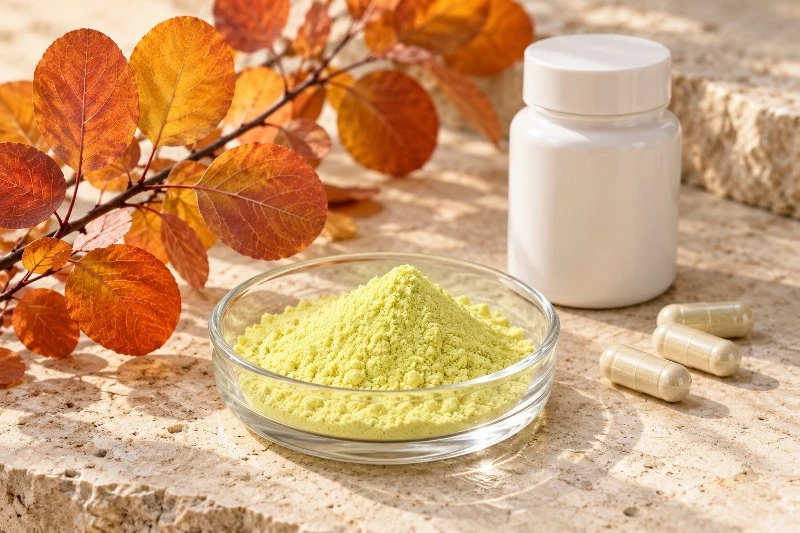
Cotinus coggygria, commonly known as smoke tree or smokebush, is the botanical source of several commercial extract ingredients, including fisetin powders. For product developers, however, the botanical name is only the starting point.A broad botanical extract, a high-assay fisetin powder, and a formulated water-soluble grade can behave differently during manufacturing. Before selecting a material, establish its composition, fisetin content, and suitability for the intended product.At Botanical Cube, we start these discussions with the customer's specification and manufacturing requirements. This helps identify which material to sample and what needs to be evaluated before a commercial order.
Start with the Right Extract Specification
1. Botanical Source and Plant Part
Ask the supplier to identify the botanical source and the plant part used. Do not assume that extracts described under the same botanical name have the same composition.The original draft refers to bark, leaves, and a particular harvesting season. Those details should only be used when they match the supplied material and are supported by sourcing records.For procurement, the specification should make the ingredient's identity clear enough for the buyer's quality team to review.
2. Fisetin Content and Ingredient Composition
Fisetin content is an important purchasing parameter, but it does not describe the entire material. Buyers should also confirm the assay method, carriers, added ingredients, and relevant physical properties.Botanical Cube offers fisetin specifications of 10%, 50%, and 98% for discussion against project requirements. The selected grade should reflect the formula, manufacturing process, and agreed acceptance criteria.A higher assay is not automatically the best choice for every application. Compare the amount of material needed, handling characteristics, formulation performance, and cost before selecting a grade.
3. Extraction and Processing Information
Extraction and purification affect the composition of a botanical ingredient. Buyers should request information relevant to the actual product, including the extraction solvent, residual solvent specification, and any subsequent formulation steps.A dual water-and-ethanol extraction process should not be described as standard for every Cotinus coggygria ingredient. Likewise, the use of a particular solvent does not, by itself, establish the safety or performance of the finished powder.
Oral Supplement Formulation
1. Capsules and Tablets
For capsules and tablets, development begins with the required fisetin amount and the assay of the selected ingredient. Calculate the corresponding extract weight before assessing capsule capacity or tablet composition.Powder flow, bulk density, particle size, and blend uniformity can affect processing. Evaluate these properties using samples under the intended manufacturing conditions.For tablets, additional work may be needed to establish compression behavior and compatibility with the chosen excipients. A satisfactory raw-material assay does not establish finished-product performance.
2. Multi-Ingredient Blends
A fisetin formula may include other botanical or nutritional ingredients, but each addition needs a defined purpose and its own assessment.
Combining fisetin with Cissus quadrangularis, pumpkin seed, bitter melon, or another extract does not establish a synergistic effect. Compatibility, ingredient amounts, intended users, and supporting evidence should be reviewed for the complete formulation.Avoid using a supplier's ingredient description as proof that a blend addresses joint pain, hormone balance, or another health outcome.
3. Taste and Sensory Properties
Taste matters when developing powders, drink mixes, chewables, or other products with direct oral exposure.Evaluate the selected material in the actual formula. Check bitterness, aftertaste, mouthfeel, and interactions with flavors and sweeteners. Results from one ingredient grade may not apply to another.Capsules can reduce direct taste exposure, but they still require an assessment of filling performance, finished-product quality, and storage stability.
Solubility and Water-Based Applications
1. Standard Fisetin Powder
Do not assume that a fisetin powder dissolves in water because it is plant-derived or described as an extract. The selected material's behavior needs to be checked before it is incorporated into a beverage, serum, or other water-based product.Distinguish dissolution from dispersion. A powder that initially spreads through water may still leave particles or settle during storage.
2. Custom Water-Soluble Grades
Botanical Cube also supports inquiries for a custom 10% water-soluble fisetin grade. This is a formulated ingredient and should be reviewed separately from conventional fisetin powders.Buyers should confirm its complete composition and assess performance at the intended use level. Relevant trial conditions include water temperature, mixing time, pH, other ingredients, and storage duration.A successful test in plain water is a useful starting point. It does not establish clarity or stability in every finished formulation.
Skincare Formulation
1. Choose the Delivery System First
For skincare development, begin with the product format and the properties of the selected extract. A toner, serum, cream, and anhydrous product present different formulation requirements.Confirm whether the material is intended to dissolve, disperse, or be incorporated through another delivery system. Then assess compatibility with the base formula.The original draft describes Cotinus coggygria extract as universally water-based. That description should be replaced with information specific to the supplied grade.
2. Evaluate Color, Texture and Stability
Check the ingredient's effect on product color, odor, viscosity, texture, and appearance after application. Examine the formula for visible particles, sediment, separation, and changes during storage.Choose the pH range through formulation and stability work. A general pH recommendation cannot establish compatibility for every extract or product base.Similarly, a universal addition range such as 0.5–2% should not be published without supporting data for the selected material and intended application.
3. Preservation and Skin Compatibility
An antioxidant and a preservative serve different purposes. Vitamin E should not be presented as a complete preservation system for a water-containing cosmetic.The finished formula needs an appropriate preservation strategy, compatibility testing, and safety assessment. Ingredient purity alone does not establish that a serum or cream will be suitable for skin application.
Stability, Packaging and Scale-Up
1. Test the Finished Formula
Raw-material shelf life and finished-product shelf life are separate questions.Evaluate the ingredient in the final formula under suitable storage and test conditions. Depending on the product, this may include appearance, assay, moisture, physical stability, microbiological quality, and packaging compatibility.If the supplier provides stability data, check whether the tested composition, packaging, and conditions are relevant to your project.
2. Confirm All Added Ingredients
Do not assume that a supplier adds tocopherols, rosemary extract, or another stabilizer. Any added ingredient should be identified in the composition and reviewed for its effect on the formula and labeling.The same applies to carriers used in water-soluble preparations. Their contribution matters when comparing grades or replacing an existing ingredient.
3. Select Packaging Around Product Requirements
Packaging should be chosen according to the product's sensitivity, handling requirements, and supporting stability results.Amber bottles, blister packs, sachets, and bulk containers offer different characteristics. None should be described as the automatic choice for every fisetin product.During scale-up, confirm that the material performs consistently through weighing, blending, filling, and packaging. Record any changes needed between laboratory trials and commercial production.
Quality Documents for Supplier Approval
1. Identity, Assay and Contaminant Testing
Request a product specification and batch Certificate of Analysis before purchase. Review the identity criteria, fisetin assay, test methods, and relevant contaminant limits against your own requirements.Available supporting reports may cover heavy metals, microbiological quality, pesticide residues, residual solvents, PAHs, and ETO-related testing. Confirm the scope and availability for the specific grade and batch.
2. Certifications and Product Claims
Review what each certificate or report covers. A manufacturing-system certificate, a product declaration, and a batch test report provide different information.Avoid broad statements that an extract "meets USP standards" unless the applicable standard and acceptance criteria are identified. Documentation should support a precise purchasing decision rather than a general quality promise.
3. Samples and Repeat Orders
Use samples to assess both analytical acceptance and manufacturing suitability. Where possible, agree on the commercial specification after trial feedback has been reviewed.For repeat orders, establish the required documentation, packaging, and acceptance criteria in advance. This gives purchasing and quality teams a consistent basis for reviewing subsequent batches.
Custom Formulation and OEM Support
A useful development brief explains what the finished product needs to do during manufacturing and storage.Include the intended application, target market, required fisetin content, preferred dosage form, other ingredients, and packaging. If you are replacing an existing material, provide its specification and describe any processing issues you want to resolve.
Botanical Cube can discuss ingredient selection, sample requirements, and available OEM/private-label options against that brief. Product-specific testing and production feasibility determine which options can be offered.Pet products require a separate assessment for the intended species and market. A human supplement formula should not be transferred directly to an animal product.

Discuss Your Fisetin Requirements
Botanical Cube supplies Cotinus coggygria extract and fisetin powder to ingredient distributors, supplement brands, researchers, and contract manufacturers. Contact us for 10%, 50%, and 98% fisetin specifications, custom water-soluble grade inquiries, samples, and available quality documentation.For bulk supply or OEM/private-label projects, email sales@botanicalcube.com with your required specification, estimated quantity, intended application, and destination country. Include your preferred dosage form and packaging requirements so we can respond with relevant options, pricing, and lead times.
References
- [1] Zhang, Y., et al. (2021). "Bioactive Compounds and Biological Activities of Cotinus coggygria Extract." Journal of Ethnopharmacology, 278, 114325.
- European Directorate for the Quality of Medicines & HealthCare. (2022). Monograph on Cotinus coggygria Extract. EDQM Guide to Quality Control for Herbal Medicinal Products.
- [2] Smith, A., et al. (2020). "Stability Considerations for Plant Extracts in Topical Skincare Formulations." International Journal of Cosmetic Science, 42(3), 245-253.
- [3] National Center for Complementary and Integrative Health. (2023). "Natural Ingredients in Dietary Supplements: Efficacy and Safety Considerations." NCCIH Publication No. DMR-23-001.
- [4] Lee, S., et al. (2019). "Synergistic Effects of Cotinus coggygria Extract and Cissus quadrangularis Extract on Joint Health." Journal of Dietary Supplements, 16(5), 589-602.