

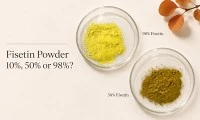

If we weigh out 100 mg of fisetin extract, the 10% grade gives us 10 mg of fisetin, the 50% grade gives us 50 mg, and the 98% grade gives us 98 mg, based on their stated concentrations. Which one would we buy? For a dry powder blend, we start by comparing 10% and 50%. For a capsule with limited room, we compare 50% and 98%. For a cold-water drink, we request a sample specifically identified as water-soluble.
At Botanical Cube, we supply conventional 10%, 50% and 98% fisetin powders from smoke tree (Cotinus coggygria), as well as a separate water-soluble 10% grade. The distinction between our two 10% products matters. Both have the same stated fisetin content, but a buyer developing a drink needs to know what happens after the powder goes into water. A capsule manufacturer has a different concern: how much of the powder will fit alongside the other ingredients? [1]
We can make the choice clearer with two purchasing examples: a 5 g powder sachet and a multi-ingredient capsule. Both are hypothetical projects. The serving targets are figures for doing the arithmetic, and the example prices are illustrative. Later, we'll look at what we actually observed in our cold-water test.
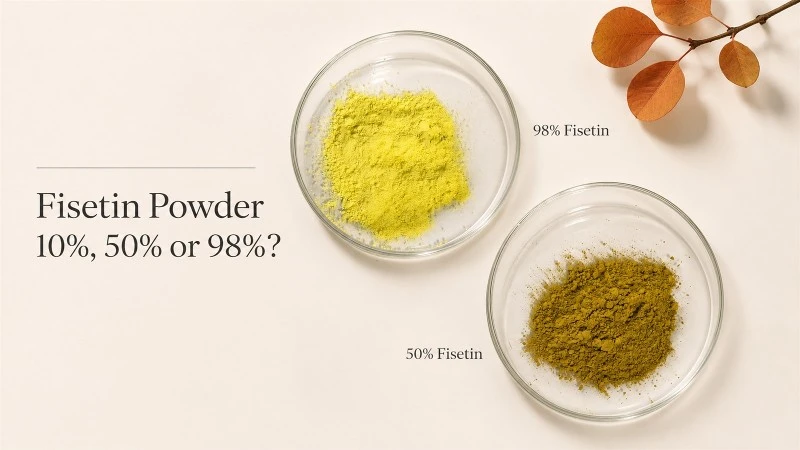
For a dry powder, when does 10% fisetin make sense?
Suppose we're making 100,000 sachets, each weighing 5 g, and the brief asks for 10 mg of fisetin per sachet. Before asking for a quote, we'd check that wording. If the brief says "10 mg of fisetin extract," then 10 mg of a 10% powder supplies only 1 mg of fisetin. That single word can change the order quantity tenfold.For our sachet, the target is 10 mg of fisetin itself. Here is what we need to weigh.
| For the same 5 g sachet | Conventional 10% | Conventional 50% |
|---|---|---|
| Powder added per sachet | 100 mg | 20 mg |
| Share of the finished sachet | 2.0% | 0.4% |
| Powder needed for 100,000 sachets, before losses | 10 kg | 2 kg |
| Fisetin supplied across the run | 1 kg | 1 kg |
The 50% grade frees up 80 mg per sachet. That space is valuable if the recipe is already full and the brand wants to keep another ingredient at its present level. If we have room to spare, we'd give the 10% grade a fair trial. We'd make one sample with 100 mg of the 10% extract and a second with 20 mg of the 50%, adjusting the base so both sachets still weigh 5 g. Our formulator can then compare color, taste and mixing behavior in the product the customer will actually receive.
Price settles the next question. We need five times as much 10% powder, so its delivered price per kilogram must be below one-fifth of the 50% price for it to save money on the fisetin ingredient consumed. If the 10% grade costs 18% as much per kilogram, our batch costs 10% less for that ingredient. If it costs 25% as much, our batch costs 25% more. The break-even point is simple enough to use while reading two supplier quotations.
For this sachet, we'd buy 10% if the trial blend is acceptable, the other components of the extract suit our recipe, and the price supports the 10 kg requirement. We'd favor 50% if its smaller addition improves the finished formula or reduces our cost per sachet. Before signing off, we'd confirm the actual lot's fisetin content and ask what other plant constituents or added carriers come with the powder. [1]
For a capsule, how much room does 98% actually save?
Let's change the brief. We now want 50 mg of fisetin in a capsule that already contains several other ingredients. We would need 500 mg of conventional 10% extract, 100 mg of 50%, or about 51 mg of 98%. Moving from 50% to 98% saves approximately 49 mg per capsule.That number gives the purchasing team a useful question for its manufacturer: How much weight can we still allocate to this ingredient in the approved formula? If the answer is 80 mg, the 50% grade already exceeds the allowance. We'd sample 98% first. If the answer is 120 mg, both candidates fit on paper, and we'd take both into a fill trial using the intended capsule shell.
The fill trial matters because the shell has a fixed volume. For example, one published supplier specification for 98% fisetin reports a loose bulk density of 0.34 g/mL and a tapped density of 0.56 g/mL. At those values, 51 mg of that particular powder occupies about 0.15 mL when loosely poured and 0.09 mL after tapping. The amount of fisetin stays the same while the space occupied changes. We use the candidate lot's density and a trial with the complete blend to decide whether production can fill it consistently. [2]
If both grades pass, there's a quick way to compare quotes. Divide 98 by 50 and we get 1.96. With comparable assays and manufacturing yields, a kilogram of 98% can cost 1.96 times the price of 50% before their fisetin ingredient cost per capsule is equal. At a price multiple of 1.8, the 98% grade costs about 8.2% less per capsule on the quantity consumed. That sounds like a reason to buy it. For a first order, we'd check one more figure: the quantity the supplier will invoice.
Why can the grade that costs less per capsule require a larger first order?
In the bulk market, pack sizes and price breaks vary. One commercial listing offers 98% fisetin in both 1 kg and 5 kg sizes at different kilogram prices. Another wholesale listing includes a 20 kg presentation alongside smaller units. When we compare suppliers, we want the total delivered price for the packs we can actually order. [3, 4]
Take a first run of 100,000 capsules, each containing 50 mg of fisetin. Suppose our hypothetical supplier sells both grades in sealed 5 kg packs. For easy comparison, assume delivered prices of $100/kg for 50% and $180/kg for 98%. These are example figures, not Botanical Cube quotations.
| First-run calculation | 50% fisetin | 98% fisetin |
|---|---|---|
| Powder needed before production losses | 10.000 kg | 5.102 kg |
| Cost of powder consumed | $1,000 | About $918 |
| Quantity purchased in whole 5 kg packs | 10 kg | 10 kg |
| Initial payment | $1,000 | $1,800 |
| Theoretical inventory remaining | 0 kg | About 4.898 kg |
The purchasing problem comes down to 102 grams. That is how far the 98% requirement extends beyond a single 5 kg pack. For a one-time trial, we'd ask for a 5 kg pack plus a smaller sealed pack and request a fresh delivered quote. For an established product with another run already scheduled, buying the second full pack could make sense if the remaining material can be used within its storage period.
Now consider what happens when the factory requests a 2% purchasing allowance above theoretical input. We need 10.20 kg of the 50% grade or about 5.204 kg of the 98% grade. Under the same whole-pack rule, the orders become 15 kg and 10 kg, with payments of $1,500 and $1,800. The first-order premium for 98% falls from 80% to 20%. Before we negotiate another dollar off the kilogram price, we'd confirm the allowance with the factory. It changes this order by an entire pack.
For a drink, what did we actually see in cold water?
In our preliminary test at Botanical Cube, we added 1 g of water-soluble 10% fisetin powder to 100 mL of cold water and stirred for 30 minutes. At that observation point, we saw no visible particles or sediment. Based on the stated 10% concentration, the gram of powder introduced approximately 100 mg of fisetin. Our observation records what the mixture looked like at 30 minutes. Determining exactly how much fisetin was dissolved would require a separate analytical measurement. [5]
How would we translate that result into a buyer's trial? If the brief calls for 50 mg of fisetin in a 100 mL drink, we'd weigh 0.5 g of the water-soluble 10% powder into the actual beverage base. We'd keep a matching glass of the base without fisetin so the product team could see the change in appearance. For a refrigerated shot, we'd agree on observation times with the buyer and record any settling after storage. For a heat-treated beverage, we'd also retain samples before and after processing for a content check.
There's a practical reason to measure content as well as look at the glass. In a published laboratory study at 37°C, researchers Jing Wang and Xin-Huai Zhao changed the test solution from pH 6.0 to pH 7.5. The measured rate constant for fisetin breakdown rose from 0.00830 to 0.202 per hour, about a 24-fold increase under those experimental conditions. We can't use those figures to predict the shelf life of a finished drink. We can use them to explain why we ask a beverage developer for the recipe's actual pH, heat process and storage conditions before recommending a stability trial. [6]

Which fisetin sample should we quote for your project?
For a powder sachet with room in the recipe, we'd quote conventional 10% and 50% against the same planned run. For a capsule that needs 50 mg of fisetin but has only 80 mg of weight available, we'd send 98% for the first fill trial. For a cold-water drink, we'd begin with water-soluble 10% and agree on the concentration to test. In each case, the first sample should answer the question most likely to change the purchase.
If you send us your product format, target fisetin per serving, first-run quantity and destination country, we can compare suitable grades for the same order and show you the available pack sizes. If your capsule is nearly full, tell us how much room remains. If you're developing a drink, tell us the serving volume. We can then provide the relevant specification and batch certificate of analysis, or discuss a custom formulation or OEM trial around your brief. Email our team at sales@botanicalcube.com.
References
[1] Botanical Cube. How to Choose a Fisetin Powder Supplier. Manufacturer information on smoke-tree fisetin grades, composition and assay reporting. www.botanicalcube.com
[2] LongWell Biotech. Fisetin. Supplier specification reporting loose bulk density, tapped density and HPLC assay for a 98% material. longwellbiotech.com
[3] GUTINS. Fisetin Powder – 98%. Commercial listing showing available pack sizes and quantity-dependent pricing. gutins.com
[4] BulkSupplements.com Wholesale. Fisetin Powder. Wholesale listing showing packaging options and ordering units. wholesale.bulksupplements.com
[5] Botanical Cube. Does Fisetin Work? Human Evidence & Fisetin Powder Guide. Company-reported preliminary cold-water observation for water-soluble fisetin 10%. www.botanicalcube.com
[6] Wang J, Zhao X-H. "Degradation kinetics of fisetin and quercetin in solutions affected by medium pH, temperature and co-existing proteins." Journal of the Serbian Chemical Society, 2016, 81(3), 243–253. DOI 10.2298/JSC150706092W. doiserbia.nb.rs