



When comparing ginger extracts for dietary supplements or functional beverages, you may see gingerol and shogaol listed on product specifications or COAs. Both are naturally occurring compounds in ginger (Zingiber officinale), but they are not the same, and their levels can change during processing.
For buyers, the key is knowing which compound matters for your product and whether the supplier's test results match your requirements. Total gingerol content alone does not tell you how much shogaol the extract contains. Understanding this difference can help you choose the right specification and avoid confusion when comparing samples and supplier offers.
1. What Is the Difference Between Gingerol and Shogaol?
To set up an accurate raw material specification, you must first understand the structural and processing dynamics that separate these two compounds.
How Do Gingerols and Shogaols Differ Chemically?
Gingerols are the principal pungent constituents found in fresh ginger rhizomes, with 6-gingerol being the most abundant homologous compound [1]. Structurally, gingerols contain a beta-hydroxy ketone group. This functional group makes the molecule thermally unstable and prone to degradation under specific environmental conditions.
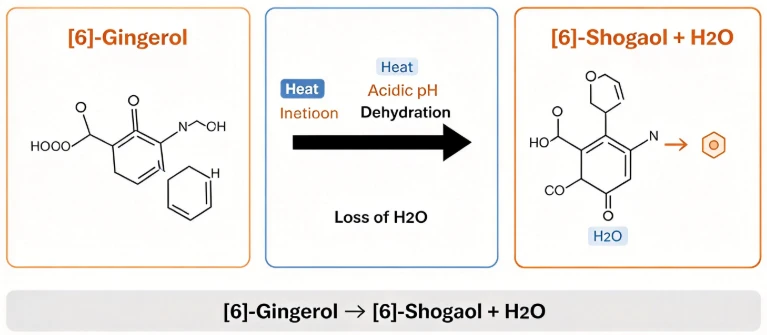
Shogaols, primarily 6-shogaol, are the dehydrated derivatives of gingerols [1]. When exposed to heat, drying, or acidic conditions, the hydroxyl group in gingerol undergoes a elimination reaction (dehydration), forming an alpha, beta-unsaturated ketone [1]. This structural shift alters the compound's bioactivity profile, pungent intensity, and stability dynamics.
How Does Processing Affect Gingerol and Shogaol Content?
Freshly harvested ginger rhizomes contain high concentrations of gingerols and virtually non-detectable levels of shogaols [2]. However, industrial processing choices directly dictate the ratio of these two active markers in your final extract.
- Fresh/Low-Temperature Drying: Preserves 6-gingerol while keeping 6-shogaol formation to a minimum.
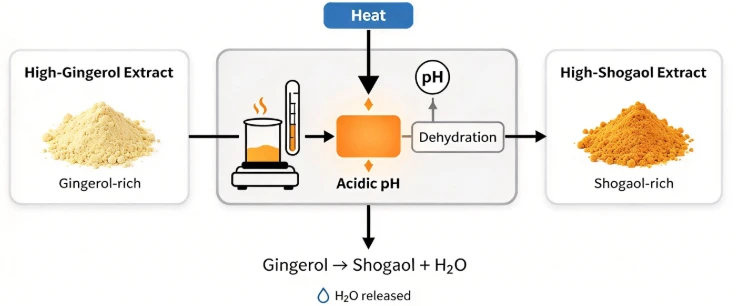
- Thermal Processing & Hot-Air Drying: Accelerates the elimination reaction, converting a significant portion of gingerols into shogaols [1, 2].
- Acid-Catalyzed Extraction: Speeds up dehydration, allowing manufacturers to yield extracts standardized to higher shogaol percentages [1].
Because heat history and extraction parameters vary across production lines, two extract samples derived from the same geographical source of raw ginger root can yield vastly different chemical fingerprints [2].
2. Which Should You Prioritize: Gingerol or Shogaol?
Neither compound is inherently "superior." The decision to standardize to Gingerols, Shogaols, or a specific ratio of both depends entirely on your product application, sensory requirements, and clinical positioning.
Which Ginger Compound Matches Your Product Requirements?
- Prioritize Gingerols for: Traditional digestive support formulations, anti-nausea supplements, and applications where a mild, fresh ginger flavor profile is required.
- Prioritize Shogaols for: Potent anti-inflammatory positioning, thermogenic/metabolic support products, and joint health formulations. Research indicates that 6-shogaol exhibits higher bioactivity in specific anti-inflammatory pathways compared to 6-gingerol, though it carries a much higher pungency profile [1].
Should You Specify Gingerol, Shogaol, or Both?
The table below outlines how to translate your product intent into clear purchasing requirements:
| Application Requirement | Primary Target Marker | Key COA Specification to Request |
| Standard Commercial Extract | Total Gingerols | Minimum Total Gingerols (HPLC) via sum of 6-, 8-, and 10-gingerol. |
| Specific Bioactivity Claim | 6-Gingerol Single Marker | Minimum 6-Gingerol content with defined tolerance windows. |
| Thermogenic / Joint Health | Target Shogaol Content | Specified 6-Shogaol percentage or defined Gingerol-to-Shogaol ratio. |
| Dual-Active Formulation | Combined Controls | Separate lower and upper limits for both Total Gingerols and 6-Shogaol. |
Critical Note: You cannot estimate Shogaol content based on a Total Gingerol figure alone. Total Gingerol testing methods often fail to capture converted shogaol fractions unless specifically set up to isolate and quantify both peaks independently [1].
3. How Should You Specify Gingerol and Shogaol Content When Buying Ginger Extract?
Miscommunication between procurement teams and ingredient manufacturers often stems from ambiguous specification terms. To avoid rejected shipments or inconsistent finished goods, define your terms precisely.
What Is the Difference Between Total Gingerols and 6-Gingerol?
"Total Gingerols" typically represents the sum of 6-gingerol, 8-gingerol, and 10-gingerol (along with 6-shogaol in some composite methods). However, 6-gingerol generally accounts for 50% to 70% of the total gingerol fraction in natural ginger root [2].
If your technical brief requires 5% 6-Gingerol, requesting a generic "5% Total Gingerols" extract will result in an under-dosed formulation. Always ask your supplier to state whether their percentage claim refers strictly to the single monomer (6-gingerol) or the sum of all homologous compounds.
Should You Specify a Minimum Content or an Exact Target?
Depending on your quality control protocols, choose one of these three specification limits:
- Minimum Limit (e.g., NLT 5.0% Total Gingerols): Best for standard dietary supplements where exceeding the minimum active content presents no formulation or safety issues.
- Target Range (e.g., 5.0% – 5.5% Total Gingerols): Essential for clinical formulations or automated tableting and encapsulation lines where active variance impacts fill weight and dissolution rates.
- Carrier & Powder Specification: Always specify whether you require a 100% Pure Extract Powder or a Standardized Carrier-Bound Powder (e.g., maltodextrin or silica carriers). Carrier ratios alter density, solubility, and flowability.
Sample Specification Sheet Fields for Your RFQ
4. How Can You Verify Gingerol and Shogaol Content in a COA?
Receiving a Certificate of Analysis with a passing numerical value is not enough. You must verify that the testing method used by the supplier is capable of differentiating and accurately quantifying the individual markers.
Does the COA Report the Specific Compound You Need?
- Check the analytical test section on the COA. If the document simply reads "Gingerols: 5.2% - Pass" without naming the specific markers (6-gingerol, 8-gingerol, 10-gingerol, 6-shogaol), request a detailed chromatogram from the testing laboratory.
How Can You Check Whether the Analytical Method Is Suitable?
High-Performance Liquid Chromatography (HPLC) is the standard method for quantifying ginger compounds [1]. However, operating conditions matter:
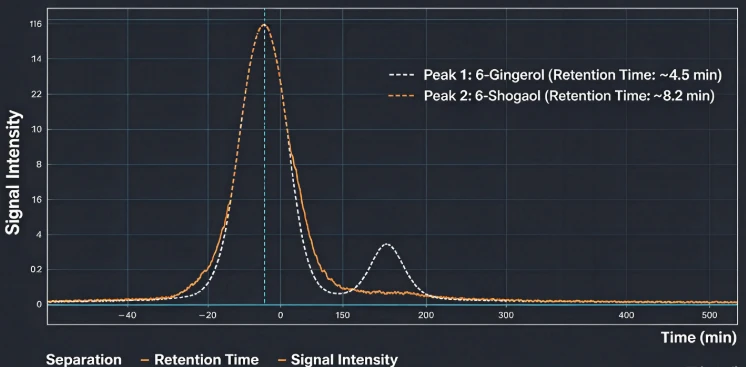
- Chromatographic Separation: The HPLC method must achieve clear baseline separation between 6-gingerol and 6-shogaol peaks. Due to their similar retention dynamics on reverse-phase columns (e.g., C18), improper mobile phase gradients can lead to overlapping peaks, artificially inflating the reported gingerol content [1].
- Reference Standards: Ensure the testing protocol uses certified Reference Standards (e.g., USP or primary analytical standards) for quantitative calibration rather than unvalidated secondary standards.
What Should You Verify Before Approving a Sample?
- Confirm that the test units on the COA match your specification sheet (e.g., mg/g vs. weight percentage %).
- Cross-check residual solvent values. Ethanol or supercritical CO2 extraction profiles differ significantly from cheaper solvent systems.
- Request third-party lab verification if your internal quality team identifies discrepancies between supplier COAs and pre-shipment sample testing.
5. What Can Cause Gingerol and Shogaol Content to Vary Between Batches?
One of the most frequent challenges in scaling up from lab samples to bulk commercial batches is batch-to-batch variation.
How Can Raw Material and Processing Affect the Compound Profile?
Natural variation in ginger rhizomes occurs due to farm location, harvest maturity, and storage humidity. However, the largest source of industrial variance is thermal inconsistency during drying and extraction.
To illustrate this, consider real-world stability testing data evaluating 6-gingerol thermal degradation in liquid extract matrices held at varying temperatures over 48 hours [1]:
| Temperature (°C) | Holding Time | Remaining 6-Gingerol (%) | Formed 6-Shogaol (%) |
| 50°C | 48 Hours | 96.2% | 0.8% |
| 75°C | 48 Hours | 81.5% | 12.1% |
| 105°C | 48 Hours | 43.8% | 38.6% |
As the data shows, unmonitored temperature spikes during spray drying or evaporation rapidly convert gingerol into shogaol, completely shifting your target profile [1].
What Batch-to-Batch Data Should You Request from a Supplier?
To protect your supply chain against consistency risks, ask your manufacturer for:
- Historical COA Trends: Review key active marker results across 3 to 5 consecutive commercial production batches.
- Accelerated Stability Reports: Data demonstrating active retention over time under controlled humidity and temperature.
- Sample-to-Bulk Guarantee: A formal commitment that bulk commercial deliveries will adhere to the exact tolerance range established during pre-shipment sample approval.
6. What Should You Check Before Choosing a Ginger Extract Supplier?
Evaluating a manufacturing partner requires looking beyond unit pricing. Your supplier must possess technical control over their thermal processing parameters and maintain a verified quality system.
Supplier Evaluation Checklist
When auditing potential manufacturing partners, verify the following core capabilities:
- Custom Ratio Capability: Can the factory precisely control thermal and extraction parameters to deliver a custom Gingerol-to-Shogaol ratio if your formulation demands it?
- Analytical Infrastructure: Does the facility operate in-house HPLC-DAD or LC-MS/MS equipment for real-time batch monitoring, or do they rely entirely on unverified external labs [1]?
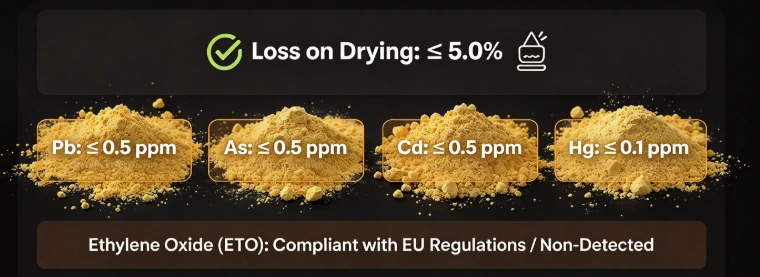
- Traceability & Document Suite: Can the supplier supply complete documentation, including Batch Production Records (BPR), Flow Charts, Allergen Statements, ETO-Free Declarations, Non-GMO Statements, and ISO/HACCP/GMP certifications?
- Supply Scalability & MOQ: Does the supplier support your development lifecycle with flexible sample quantities, reasonable Minimum Order Quantities (MOQs), and commercial bulk inventory?
7. How Can You Prepare a Ginger Extract Inquiry That Gets You the Right Specification?
To streamline your procurement cycle and receive accurate, actionable technical quotes, avoid vague requests like "Please quote on Ginger Extract Powder." Instead, provide your supplier with a complete inquiry profile using the template below:
Procurement Inquiry Template
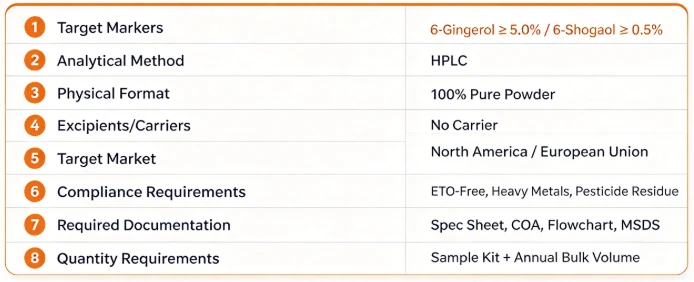
By providing these parameters up front, you eliminate back-and-forth technical clarifications, ensure quoted prices reflect your exact quality requirements, and accelerate your time-to-market.
Ginger Extract: Gingerol & Shogaol Sourcing Support
The right ginger extract depends on more than its stated gingerol content. If shogaol is also important to your formulation, check whether it is included in the specification and reported separately in the COA.At Botanical Cube, we can help you review available ginger extract options, clarify active marker specifications, and assess product data before you make a sourcing decision.Whether you are evaluating a sample or planning a bulk purchase, email sales@botanicalcube.com with your target content and application. This will help us understand your needs and identify suitable options for further evaluation.
References
[1] PMC Article: Gingerols and shogaols: A multi-faceted review of their extraction, formulation, and analysis in drugs and biofluids to maximize their nutraceutical and pharmaceutical applications.
[2] ScienceDirect Study: Quantitative profiling of gingerol and its derivatives in Australian ginger.