



When customers ask us about ginger extract powder, one of the first questions is often simple: "Which specification should I choose?"
At first, it may seem that the answer is just a matter of gingerol content-5%, 10%, 20%, or higher. But once we start discussing the actual application, the decision becomes much more specific. Is the extract going into a capsule, tablet, beverage, instant drink, or another food formulation? Does it need to disperse easily in water? How much ginger taste is acceptable? What analytical method is being used for the gingerol specification? Does the product contain a carrier? And can the same specification be maintained when the order moves from a small sample to bulk production?
These details can make a significant difference when comparing ginger extract powders from different suppliers.From a manufacturing perspective, we do not recommend choosing an extract simply because it has the highest gingerol content or the lowest price. The more important question is whether the specification matches the application and whether the quality can be verified and maintained from batch to batch.
In this guide, we will break down the main factors we recommend checking when evaluating ginger extract powder, including application requirements, gingerol content, testing methods, solubility, processing, contaminants, batch consistency, and commercial terms.
Step 1: Clarify Your Product Application & Formula Requirements
Before sending out an RFQ (Request for Quotation), your team must define the exact physical and sensory parameters required by your target delivery form. A ginger extract that performs exceptionally well in a hard capsule can fail completely in an RTD (Ready-to-Drink) beverage.
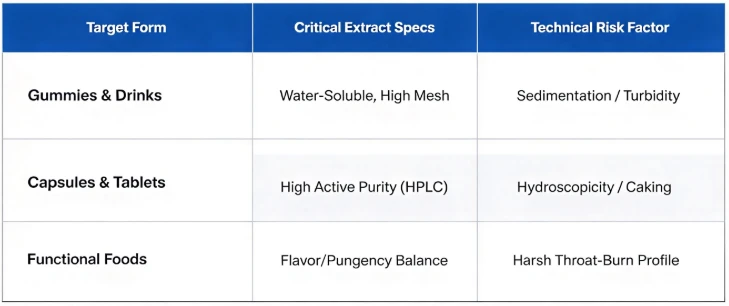
Water-Soluble vs. Standard Powder: Which One Matches Your Dosage Form?
Standard ginger extracts contain lipid-soluble gingerols and essential oils. In an aqueous system like a functional beverage, shot, or clear liquid sachet, standard powders create unsightly oil rings, floating flecks, or dense sediment at the bottom of the bottle.
For liquid applications, you must specify a cold-water-soluble grade.
- Particle Size (Mesh): Standard grades typically run between 80 mesh and 100 mesh. Water-soluble grades require ultra-fine milling (120 to 200 mesh) combined with specialized carrier emulsification to dissolve rapidly without high-shear mixing.
- Turbidity (NTU): A premium water-soluble extract should achieve a turbidity reading below 15 NTU at a 1.0% solution concentration in room-temperature water (25℃)fully clarifying within 30 seconds [1].
- pH Stability: Ensure the solution maintains clarity across acidic ranges (pH 3.2 - 4.5), which are standard for functional drinks containing citric or malic acid.
In our lab testing at Botanical Cube, standard 80-mesh powders showed visible particulate drop-out within 120 seconds of mixing, whereas our 120-mesh cold-water-soluble ginger extract maintained complete optical clarity for over 72 hours under ambient shelf storage.
Purity vs. Flavor Balance: How to Choose the Right Marker Compound Concentration?
Ginger extract concentrations generally range from 1% to 20% Gingerols (with specialized supercritical extracts reaching even higher purity). Higher concentration is not always better for your formula; it is a trade-off between bioactivity, raw material cost, and sensory tolerance.
| Active Spec (% Gingerols) | Sensory Profile | Primary Application | Recommended Usage Level |
| 1.0% – 2.5% | Mild ginger warmth, pleasant aroma | Functional gummies, chews, teas | 150 mg – 300 mg per serving |
| 5.0% Standard | Moderate-to-high pungency, sharp finish | Dietary supplements, hard capsules | 100 mg – 200 mg per serving |
| 10.0% – 20.0%+ | Extreme throat burn, intense pungency | High-potency clinical doses, small capsules | 20 mg – 50 mg per serving |
If your development team is formulating a gummy or chewable tablet, choosing a 10% or 20% gingerol extract without proper organoleptic masking will cause severe throat irritation for consumers. Conversely, for a compact multi-ingredient capsule, a high-potency extract minimizes fill volume, leaving room for other active ingredients.
Step 2: Decode the Technical Specs & Quality Standard (HPLC vs. UV Trap)
The most common financial trap in ingredient sourcing occurs right at the analytical method line on the Certificate of Analysis (CoA). A vendor offering "5% Gingerols" at a 30% discount is often hiding behind an inferior testing method.
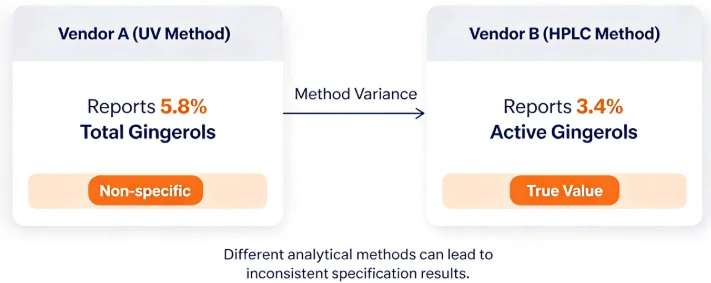
HPLC vs. UV Testing: Why Spec Differences Can Be Deceptive
Ultraviolet-Visible Spectroscopy (UV) measures overall light absorption at a specific wavelength. It cannot distinguish between true bio-active gingerols, degraded breakdown products, or added aromatic adulterants. UV frequently overstates active gingerol content by 20%to 45% compared to High-Performance Liquid Chromatography (HPLC) [2].
Pharmacopeial standards such as the United States Pharmacopeia (USP) and European Pharmacopoeia (EP) strictly require HPLC assay testing [2]. HPLC separates and quantifies the specific individual marker compounds:
- 6-Gingerol (The primary active pungent component)
- 8-Gingerol
- 10-Gingerol
- 6-Shogaol
When reviewing supplier quotes, insist on seeing an HPLC chromatogram. A quote for 5% Gingerols by UV is functionally equivalent to roughly 3.2%–3.5% Gingerols by HPLC. Comparing UV pricing against HPLC pricing is comparing apples to oranges.
Gingerols vs. Shogaols Ratio: The Key to Efficacy and Freshness
Fresh ginger rhizomes are rich in 6-gingerol. When ginger undergoes thermal drying and extraction, gingerols dehydrate into shogaols (primarily 6-shogaol), which exhibit up to twice the relative pungency and distinct anti-inflammatory properties [3].
A high-quality fresh extract typically maintains a Gingerols-to-Shogaols ratio between 5:1 and 9:1 [3]. If a CoA shows an abnormally high concentration of 6-shogaol relative to 6-gingerol (e.g., a ratio lower than 2:1), it indicates that the raw material was exposed to excessive heat during drying or extraction. Excessive thermal degradation reduces the full-spectrum bio-potency of the extract and destabilizes its shelf life.
Step 3: Assess Contaminant Risks and Global Regulatory Compliance
An ingredient can meet every physical and active assay target, yet still cause complete shipment rejections at customs if heavy metals, pesticide residues, or organic solvent levels exceed regional limits.
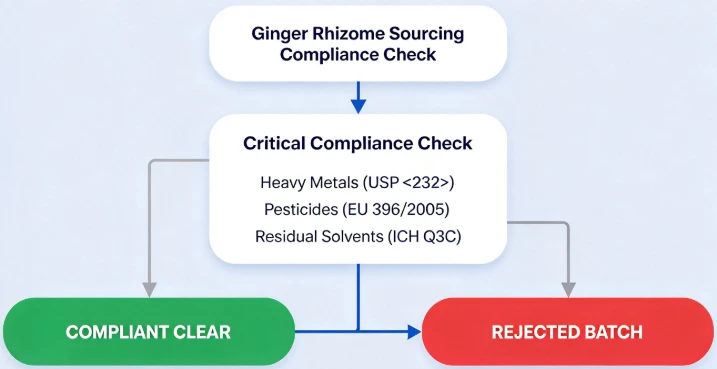
Solvent Residues and Heavy Metals: Meeting FDA & EFSA Tolerances
Ginger is a root crop that naturally absorbs minerals-and heavy metals-from the soil. Furthermore, traditional extraction methods relying on low-grade organic solvents can leave toxic residues in the final powder.
- Heavy Metal Thresholds
To pass strict North American and European audits, raw material must strictly align with USP and European Commission limits [4]:
Lead (Pb): < 0.5 ppm
Arsenic (As): < 1.5 ppm
Cadmium (Cd): < 0.5 ppm
Mercury (Hg): < 0.1 ppm
- Residual Solvents
Ethanol and water extraction yields the cleanest toxicological profile. If solvents like ethyl acetate or acetone are used, residual levels must strictly comply with ICH Q3C Class 2/3 limits (typically < 50 ppm for industrial specifications) [5].
At Botanical Cube, we utilize Supercritical CO2 Extraction technology. Because carbon dioxide reverts to gas upon pressure release, our extracts contain zero organic solvent residues, verified by independent ISO 17025 accredited third-party testing labs such as SGS and Eurofins.
Carrier & Excipients Transparency: What Is Inside Your Powder?
High-potency ginger extracts are sticky, viscous oleoresins in their raw state. Converting them into stable, flowable powders requires spray drying with carrier excipients.
Ask your prospective vendor for full carrier disclosure:
- What carrier is used? (Non-GMO Maltodextrin, Acacia Gum, or Starch?)
- What is the exact ratio? (e.g., 80% Ginger Extract to 20% Carrier vs. 50/50%)
Unannounced carrier adjustments change your product's label declaration, mess up clean-label claims (such as organic or non-GMO), and dramatically alter bulk density during large-scale manufacturing.
Step 4: Evaluate Supply Chain Stability & Manufacturing Process
Spotting a great 100g sample is easy. Securing 2,000 kilograms of identical, high-flowability powder every quarter requires evaluating the factory's processing controls and fraud-prevention protocols.
How to Spot Synthetic or Adulterated Ginger Extracts?
Due to price fluctuations in raw ginger rhizomes, market adulteration remains a persistent issue. The most common economic adulteration methods include:
- Capsaicinoid Spiking: Blending cheap chili pepper extract (capsaicin) into low-grade ginger powder to artificially inflate pungency and pass basic sensory tests.
- Synthetic Gingerol Fortification: Adding synthetic pungent agents to bypass low-resolution testing.
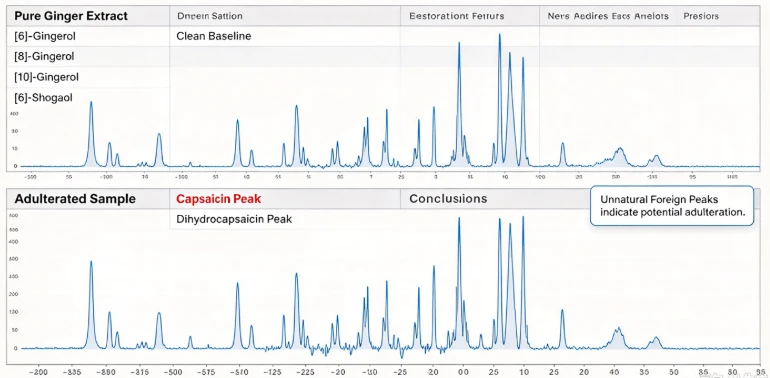
How to safeguard your supply chain
- HPLC Fingerprinting: Inspect the baseline chromatogram. Genuine ginger extract exhibits a distinct, natural ratio of 6-, 8-, and 10-gingerols. Spiked capsaicin produces anomalous peaks before and after 8-gingerol [6].
- Carbon-14 (14C) Isotope Testing: For high-value orders, radio-carbon testing verifies whether active compounds are 100% bio-based or derived from synthetic petrochemical precursors [6].
At Botanical Cube, every outgoing batch is accompanied by a full-spectrum HPLC fingerprint report, guaranteeing zero capsaicinoid cross-contamination and 100% botanical authenticity.
Ensuring Batch-to-Batch Consistency: Drying Technology & Moisture Control
Ginger extract powder is inherently hygroscopic-it readily absorbs environmental moisture, leading to clumping, caking, and microbial growth inside the drum.
- Spray Drying vs. Vacuum Belt Drying: Spray drying offers uniform particle morphology, but high inlet temperatures can compromise heat-sensitive gingerols if exposure time isn't tightly controlled. Low-temperature Vacuum Belt Drying preserves native aroma and heat-sensitive actives while delivering superior water rehydration rates.
- Packaging Defense: Industrial drums must utilize double-layer, heat-sealed aluminum foil bags with enclosed desiccant packs. Powder moisture content should consistently measure below 5.0% at final packaging.
Step 5: Cost Breakdown, MOQ, and Commercial Terms Negotiation
Understanding the raw material cost structure helps procurement teams negotiate fair commercial pricing without sacrificing finished product safety.
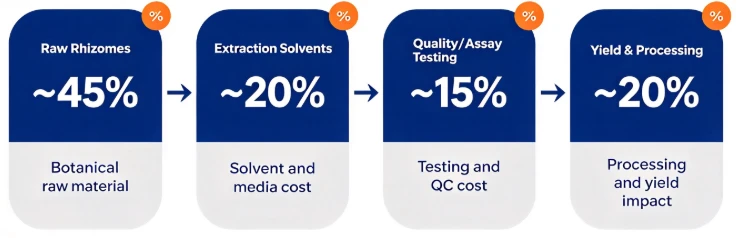
What Drives the Price of Ginger Extract Powder?
The price of ginger extract powder is governed by four primary variables:
- Raw Rhizome Market Cost: Fresh ginger yields roughly a 10:1 to 15:1 wet-to-dry ratio. Spikes in fresh agriculture prices directly impact raw material costs.
- Target Active Concentration: Extracting 10% HPLC Gingerols requires significantly more raw biomass and refined purification passes than producing a 1% standard powder.
- Extraction Tech: Supercritical CO2 extraction carries higher equipment capital costs than simple ethanol extraction, but yields a solvent-free, premium-tier raw material.
- Compliance Testing: Rigorous third-party screening (screening for over 400 pesticide residues, heavy metals, and isotopic authenticity) adds tangible value and safety to every batch.
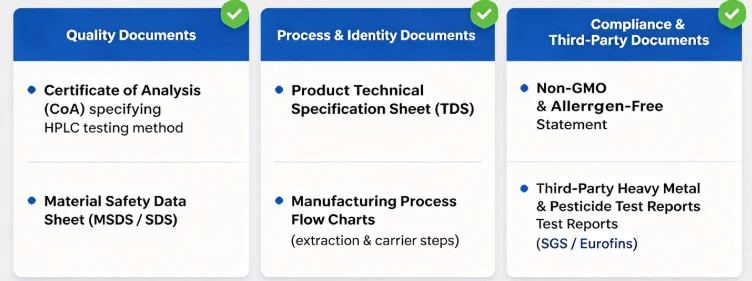
Key Audit Checklist Before Placing a Trial Order
Before issuing a formal Purchase Order (PO), request these seven non-negotiable compliance documents from your supplier's quality assurance department:
Need Help Choosing the Right Ginger Extract Powder?
Choosing a ginger extract powder is ultimately about finding the right balance between gingerol specification, application requirements, analytical testing, product consistency, and supply conditions. A specification that looks good on paper may not always be the best fit for your formulation, so sample evaluation and clear quality documentation are important before moving to bulk purchasing.
At Botanical Cube, we supply different ginger extract powder grades, including standard ginger extract powder, water-soluble ginger extract, and ginger CO₂ extracts, with gingerol specifications available for different applications. We can also discuss particle size, carrier requirements, packaging, and other product specifications based on your formulation and target market.
For customers comparing ginger extract suppliers, we can provide:
- Customized specification sheets and HPLC testing data for gingerol-related specifications.
- 50g evaluation samples of suitable standard or water-soluble ginger extract grades for laboratory trials.
- Heavy metal, pesticide, and other quality testing documents according to the requirements of the target market.
- Customized particle sizes and product specifications when standard grades do not fit your formulation.
If you are developing a new product, comparing ginger extract powder suppliers, or need a specific gingerol specification, send us your target application, specification, estimated quantity, and destination market. We can help you check suitable grades and discuss a practical solution before bulk purchasing.Contact us at sales@botanicalcube.com.
References
[1] Section: Step 1, "Water-Soluble vs. Standard Powder", Paragraph 3: Evaluated based on beverage industry turbidity and solubility profiling standards for spray-dried botanical extracts. Journal of Food Science and Technology, 58(4), 1240–1249 (2021).
[2] Section: Step 2, "HPLC vs. UV Testing", Paragraph 2 & 3: United States Pharmacopeial Convention. USP–NF Monograph: Ginger (Zingiber officinale) Rhizome Powder and Extract. USP 43–NF 38. High-Performance Liquid Chromatography (HPLC) assay requirements for gingerols and 6-shogaol.
[3] Section: Step 2, "Gingerols vs. Shogaols Ratio", Paragraph 1 & 2: Thermal degradation kinetics of 6-gingerol to 6-shogaol during industrial drying processes. Food Chemistry, 239, 560–568 (2018).
[4] Section: Step 3, "Solvent Residues and Heavy Metals", Paragraph 2: European Parliament and Council Regulation (EC) No 396/2005 on maximum residue levels of pesticides in food and feed; USP General Chapter Elemental Impurities-Limits.
[5] Section: Step 3, "Solvent Residues and Heavy Metals", Paragraph 2: International Council for Harmonisation (ICH) Harmonised Guideline. Impurities: Guideline for Residual Solvents Q3C(R8) (2021).
[6] Section: Step 4, "How to Spot Synthetic or Adulterated Ginger Extracts?", Paragraph 2: Detection of adulteration and capsaicinoid cross-contamination in botanical extracts using liquid chromatography-mass spectrometry (LC-MS) and isotope ratio mass spectrometry (IRMS). Journal of Agricultural and Food Chemistry, 67(11), 3210–3218 (2019).