




When comparing Saw Palmetto Extract from different suppliers, a high extract ratio or a simple "standardized extract" claim does not tell the whole story. What matters more is what is actually present in the finished extract.
Fatty acids are one of the key parameters to look at. Total fatty acid content shows the overall level, while the individual fatty acid profile provides more detail about the composition of the extract. For buyers, looking at both can make it easier to compare specifications, assess consistency, and decide whether a material meets the requirements of a formulation.
1. Why Do Fatty Acids Matter When Buying Saw Palmetto Extract?
1.1 Are fatty acids a key quality marker for Saw Palmetto Extract?
Raw plant ratio claims can vary significantly depending on harvest timing, fruit moisture, and processing conditions. Fatty acids are the bioactive constituents responsible for 5-alpha-reductase inhibition, which underpins the health applications of Saw Palmetto (Serenoa repens) [1]. Evaluating total fatty acid content provides an objective benchmark for raw material quality.
The standard reference for Saw Palmetto Extract identity comes from official pharmacopeial monographs. The U.S. Pharmacopeia (USP) standard for Saw Palmetto Extract requires:
- Total Fatty Acids: Not less than (NLT) 80.0%
- Total Sterols: NLT 0.2%
- β-Sitosterol: NLT 0.1%
Fatty acids and phytosterols work together within the plant matrix. While total fatty acids establish the bulk standardization, sterol content-particularly β-sitosterol-serves as a secondary identity marker to confirm botanical integrity.
1.2 Does a higher total fatty acid percentage automatically mean a better extract?
It is common to assume that a 95% total fatty acid specification is inherently superior to an 85% specification. However, percentage alone does not tell the whole story.
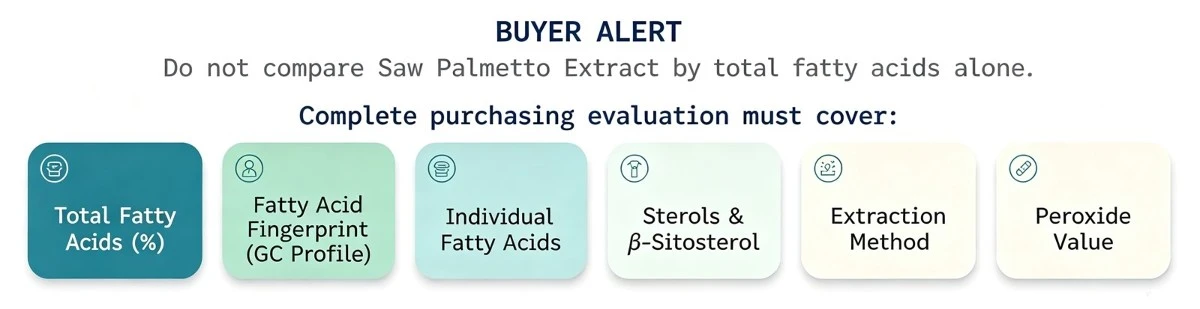
Total fatty acid content is a standardization metric, not an absolute quality score. An extract showing 90% total fatty acids could still be adulterated with inexpensive plant oils (such as coconut or palm kernel oil) if the individual fatty acid proportions are incorrect [2]. To properly evaluate an extract, buyers must look beyond the total percentage and inspect the fatty acid profile, sterol content, and oxidation markers like peroxide value.
2. Which Fatty Acid Parameters Should Buyers Check?
2.1 What does "Total Fatty Acids" actually tell you?
Total fatty acids measure the sum of free fatty acids and bound fatty acid esters within the extract. Commercial specifications typically range from ≥80%, ≥85%, to 85%–95% for liquid oil extracts, and around 45% for microencapsulated powder formats.
While a Certificate of Analysis (COA) displaying "≥85% Total Fatty Acids" confirms basic potency, it does not confirm botanical purity on its own. It represents the starting point of the technical review, not the final decision.
2.2 Why is lauric acid often listed separately?
Lauric acid (C12:0) is one of the most prominent fatty acids in genuine Serenoa repens fruit oil. Because of its abundance and bioactivity, many commercial specifications highlight lauric acid separately alongside total fatty acids and β-sitosterol.
For example, premium commercial standards often specify:
- Total Fatty Acids: ≥80.0%
- Lauric Acid: ≥23.0%
- Total Sterols: ≥0.20%
- β-Sitosterol: ≥0.10%
While lauric acid is a vital benchmark, it cannot be relied upon in isolation. Coconut oil and palm kernel oil are also rich in lauric acid, making full fingerprint analysis essential.
2.3 Why should buyers look at the fatty acid profile, not only the total?
A complete Gas Chromatography (GC) assay quantifies individual fatty acid methyl esters (FAME). Authentic Saw Palmetto Oil contains a characteristic distribution of fatty acids that forms a unique chemical fingerprint [3].
| Item | Specification / Typical Range | Why Buyers Check It |
| Total Fatty Acids | NLT 80.0% (USP) | Overall standardization & potency benchmark |
| Lauric Acid (C12:0) | NLT 23.0% | Primary individual marker acid |
| Myristic Acid (C14:0) | 9.0% – 14.0% | Profile consistency check |
| Oleic Acid (C18:1) | 20.0% – 30.0% | Major monounsaturated fatty acid marker |
| Palmitic Acid (C16:0) | 8.0% – 13.0% | Key saturated fatty acid ratio |
| Linoleic Acid (C18:2) | 3.0% – 6.0% | Essential fatty acid balance |
| β-Sitosterol | NLT 0.10% | Specific phytosterol identification |
| Total Sterols | NLT 0.20% | Overall phytosterol matrix check |
3. Is "85% Fatty Acids" Enough to Compare Two Suppliers?
3.1 Why can two 85% Saw Palmetto Extracts still be different?
Two extracts with identical "≥85% Total Fatty Acid" claims on their specification sheets can perform differently in finished formulations. These discrepancies stem from underlying variable factors:
Harvest / Maturity ──► Extraction Tech ──► Analytical Method ──► Final Profile (Fruit Quality) (CO2 vs Solvent) (GC-FID Standard) (Authenticity)
Differences in fruit maturity at harvest, drying methods, extraction temperatures, and analytical methodologies (e.g., GC-FID versus gravimetric estimation) directly impact the final chemical composition.
3.2 Should buyers compare the full COA instead of one specification?
A headline specification sheet is a sales summary. The batch Certificate of Analysis (COA) is the technical proof.
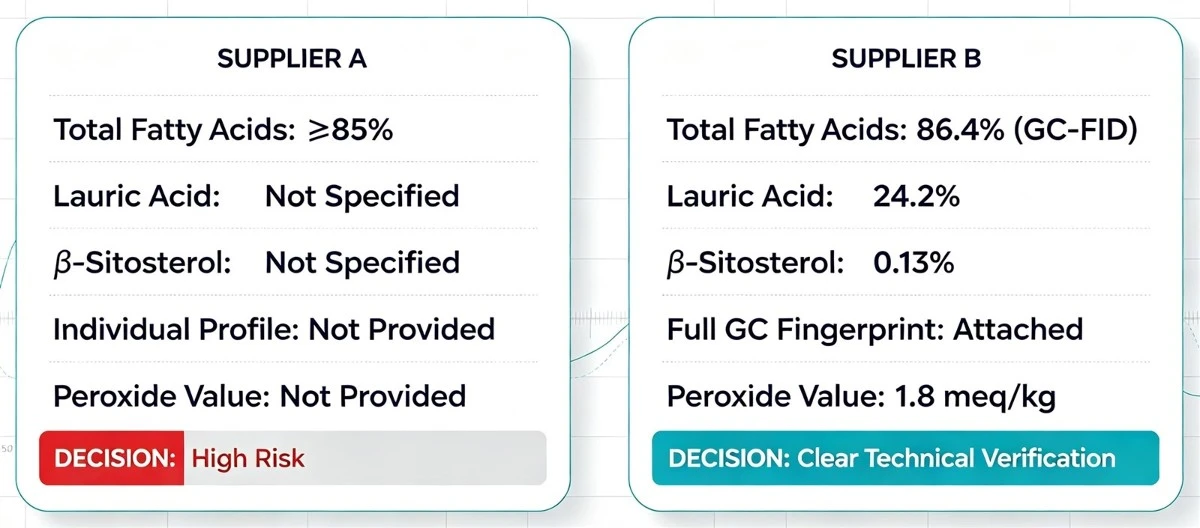
Supplier B provides the necessary transparency to verify authenticity, shelf-life stability, and regulatory readiness.
3.3 What does a fatty acid fingerprint tell buyers?
Gas chromatography analysis measures the precise ratios between fatty acids, such as the ratio of Lauric acid (C12:0) to Oleic acid (C18:1) or Myristic acid (C14:0). If an extract shows elevated levels of C18:1 or C18:2 that fall outside expected monograph ranges, it indicates potential blending with sunflower, canola, or soybean oil.
4. How Does Extraction Method Affect the Fatty Acid Profile?
4.1 What extraction methods are commonly used for Saw Palmetto Extract?
Commercial Saw Palmetto extraction relies on three main technical routes recognized in pharmacopeial frameworks:
- Supercritical CO2 Extraction
Uses carbon dioxide under high pressure. Leaves no chemical solvent residues and yields a clean, high-purity oil (typically 85%–90% total fatty acids).
- Ethanol / Hydroalcoholic Extraction
Traditional solvent extraction method yielding a dark oil or soft extract rich in both fatty acids and native polar compounds.
- Hexane Extraction
Highly efficient industrial solvent extraction, widely used for high-volume commercial production.
4.2 Does extraction method determine the final fatty acid specification?
While Supercritical CO2 extraction is praised for its clean processing and absence of organic solvents, a properly executed ethanolic or hexane extraction can also meet full USP specifications. The choice of extraction method influences physical appearance, color, residual solvent requirements, and cost economics.
4.3 What should buyers ask suppliers about extraction?
When requesting quotes, we recommend asking suppliers the following eight technical questions:
- What extraction method is used (CO2, Ethanol, or Hexane)?
- What solvent limits are guaranteed on the finished product?
- What is the standardized total fatty acid concentration?
- What is the typical lauric acid content and full GC profile?
- What is the peroxide value limit at the time of batch release?
- Is the phytosterol content (specifically β-sitosterol) quantified?
- What is the raw material origin and harvest control protocol?
- Is the extract available in microencapsulated powder format for tablet/capsule applications?
5. How Can Fatty Acids Help Buyers Check Extract Authenticity and Consistency?
5.1 Can fatty acid testing help identify adulteration or inconsistent material?
Fatty acid profiling via Gas Chromatography (GC-FID) is one of the most reliable ways to detect economic adulteration [4]. When low-cost vegetable oils are added to Saw Palmetto Extract, the total fatty acid percentage might remain high, but the individual peak areas on the chromatogram shift dramatically.
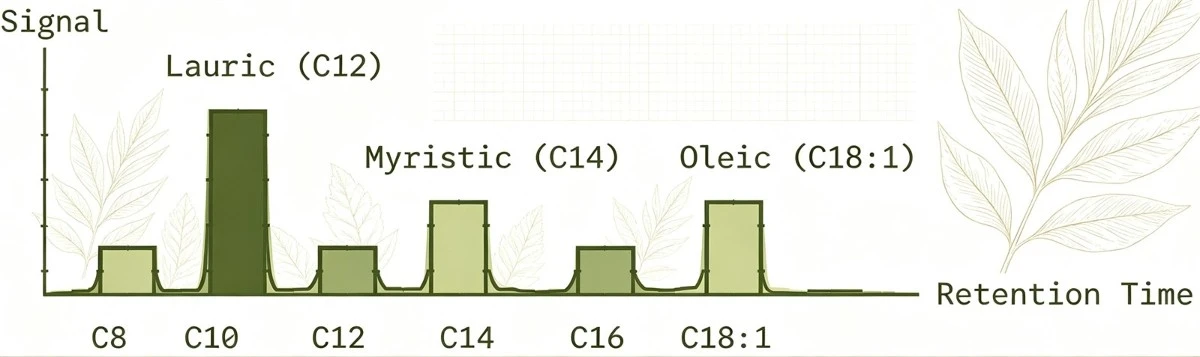
A normal chromatogram exhibits prominent C12:0 and C18:1 peaks paired with appropriate proportions of C8:0, C10:0, C14:0, and C16:0. A deviation in these ratios signals potential adulteration.
5.2 Why is batch-to-batch consistency important?
For supplement brand owners and contract manufacturers, variation between raw material lots creates manufacturing and compliance issues:
- Dosage Uniformity: Softgel encapsulation requires consistent viscosity and active density.
- Organoleptic Stability: Fluctuations in free fatty acid content affect smell, color, and taste.
- Regulatory Audits: Divergent COA values across batches can trigger regulatory inquiries during routine compliance reviews.
5.3 What should be compared between the sample COA and production COA?
Before releasing a commercial order to production, compare the pre-shipment COA against your approved evaluation sample across these crucial testing parameters:
- Total Fatty Acid Percentage (GC)
- Lauric Acid Percentage
- β-Sitosterol Content
- Peroxide Value & Acid Value
- Heavy Metal Limits (Arsenic, Cadmium, Lead, Mercury)
- Microbiological Counts (TPC, Yeast & Mold, Pathogens)
- Residual Solvent Levels
6. What Should Be Included in a Saw Palmetto Extract Specification?
6.1 What should a basic commercial specification include?
A comprehensive commercial specification sheet establishes clear legal and technical requirements between buyer and manufacturer.
| Specification Parameter | Standard Requirement | Buyer Verification Method |
| Botanical Source | Serenoa repens (Bartram) Small | Microscopic / DNA / Chain of Custody |
| Plant Part Used | Mature Ripe Fruit | Farm Sourcing Control |
| Physical Form | Dark oily liquid (Oil) or Free-flowing powder | Physical Inspection |
| Total Fatty Acids | ≥85.0% (Oil) or ≥45.0% (Powder) | GC-FID Analysis |
| Lauric Acid | ≥23.0% | GC-FID Analysis |
| β-Sitosterol | ≥0.10% | HPLC Analysis |
| Heavy Metals | Pb ≤3.0 ppm, As ≤2.0 ppm, Cd ≤1.0 ppm, Hg ≤0.1 ppm | ICP-MS |
| Pesticide Residues | USP / EP Compliant Limits | GC-MS / LC-MS |
| Microbiology | Total Plate Count <1000 cfu/g, Pathogens Negative | USP <2021/2022> |
6.2 Which tests should buyers request before placing a bulk order?
We categorize pre-purchase documentation into mandatory testing requirements and application-specific parameters:
- Mandatory Technical Package
Batch Certificate of Analysis (COA), Technical Data Sheet (TDS), Safety Data Sheet (SDS), Fatty Acid GC Chromatogram.
- Application-Specific Requirements
Residual Solvent Report (for solvent extractions), Allergen Statement, Non-GMO Declaration, BSE/TSE Statement, Heavy Metal & Pesticide Screen.
7. What Evidence Should Buyers Request From a Saw Palmetto Extract Supplier?
7.1 What should a supplier provide before quotation?
A qualified raw material supplier should provide a complete initial verification package prior to final pricing:
- Product Specification Sheet detailing guaranteed minimums.
- Representative Batch COAs from recent production lots.
- Packaging Options (e.g., 5 kg aluminum drums, 20 kg steel drums, microencapsulated powder in foil bags).
- Minimum Order Quantity (MOQ) and Lead Time terms.
7.2 What should be verified before bulk purchase?
Before issuing a Purchase Order (PO), verify batch-level traceability. Ensure that the supplier can match raw berry sourcing batches directly to finished extraction lot numbers.
7.3 Why should buyers test the sample before confirming a large order?
Sample approval does not equal commercial batch approval. Always retain a portion of the pre-shipment approval sample. When the bulk shipment arrives at your warehouse, perform identity and assay testing (Total Fatty Acids, Lauric Acid, Moisture, Heavy Metals) to confirm that the delivered material matches the approved pre-shipment sample.
8. How to Choose a Saw Palmetto Extract Supplier Based on Fatty Acid Data
When evaluating prospective manufacturing partners, look for suppliers that provide complete analytical transparency rather than minimum specification sheets.
8.1 Can the supplier provide a defined fatty acid specification?
A reliable supplier provides clear assay limits, specific GC profile boundaries, and full documentation for both oil and powder formats.
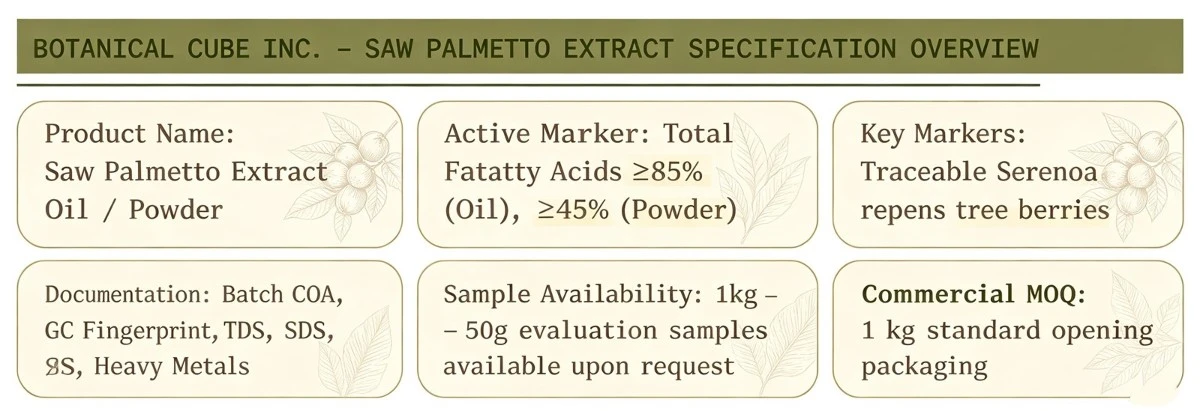
At Botanical Cube Inc., Saw Palmetto Extract is supplied with specifications buyers can verify-not just a standardization claim. Each batch is tested by GC to confirm total fatty acids and the fatty acid profile before shipment.
For different formulation needs, we supply 85%–90% Supercritical CO₂ Saw Palmetto Oil for softgels and 45% microencapsulated Saw Palmetto Powder for tablets and hard-shell capsules. Custom specifications are also available based on your formulation and quality requirements.
8.2 Can the supplier provide samples and technical documents before bulk purchasing?
Working with a responsive supplier simplifies technical review. We support formulation and QA teams by providing evaluation samples (10g–50g) alongside complete batch COAs, GC chromatograms, and technical data sheets prior to commercial commitments.
8.3 Can the specification be adjusted for different formulation requirements?
Different delivery formats require tailored material characteristics. Softgels require controlled viscosity and clear oil appearance, while solid dosage forms demand free-flowing powder with low oil-bleeding characteristics. Suppliers with custom batch capability can fine-tune oil viscosity, particle size, or carrier bases to meet specific manufacturing requirements.
9. What Should You Ask Before Buying Saw Palmetto Extract?
9.1 Saw Palmetto Extract Buyer Checklist
Use these eight essential questions during your next raw material evaluation:
- Is the raw material derived exclusively from mature Serenoa repens berries?
- What is the standardized Total Fatty Acid percentage, and what testing method (GC-FID vs. Gravimetric) is used?
- What is the guaranteed Lauric Acid percentage in the specification?
- Can you provide a full Gas Chromatography (GC) fatty acid fingerprint for the current batch?
- What are the tested levels for total phytosterols and β-sitosterol?
- Which extraction method (Supercritical CO2, Ethanol, or Hexane) was used?
- What are the peroxide value and acid value limits for batch release?
- Can you supply a 10g–50g evaluation sample along with a matching pre-shipment COA?
10. Need a Saw Palmetto Extract Specification or Sample?
Comparing Saw Palmetto Extract suppliers? Send us your target fatty acid specification, dosage form, or reference COA. Our team can match it with a suitable extract and provide the technical documents needed for evaluation.
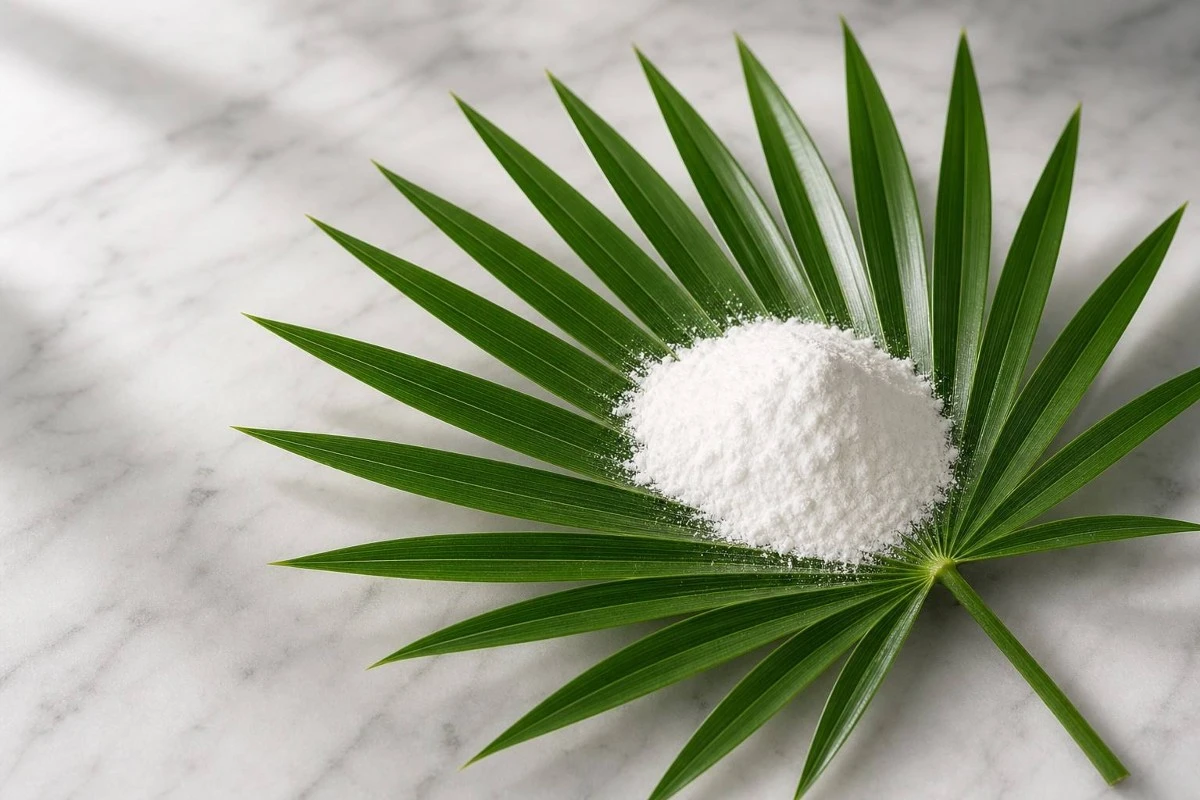
Depending on your formulation, we can supply 85%–90% Total Fatty Acids Saw Palmetto Oil for softgels or 45% Total Fatty Acids Microencapsulated Saw Palmetto Powder for tablets and hard-shell capsules.For evaluation, we can provide a product specification, recent batch COA, GC data, and sample so your technical or QA team can review the material before placing an order.
Botanical Cube Inc.
Custom Specifications | COA & GC Data | Sample Evaluation
References
[1] Penugonda, K., & Lindshield, B. L. (2013). Fatty acid and phytosterol content of commercial saw palmetto supplements. Nutrients, 5(9), 3617–3633.
[2] Booker, A., Suter, A., Krüger, P., et al. (2014). Quality and authenticity assessment of Saw Palmetto (Serenoa repens) oils and plant extracts. Phytomedicine, 21(13), 1583–1590.
[3] United States Pharmacopeia (USP). Monograph: Saw Palmetto Extract. USP-NF.
[4] Suter, A., Saller, R., Riedi, O., & Heinrich, M. (2013). Improving the quality of saw palmetto preparations: Analytical techniques and fatty acid profiling. Journal of Herbal Medicine, 3(2), 41–48.