

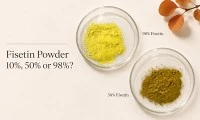
Suppose you need 5 kg of fisetin powder. Your formulator has asked for at least 98% fisetin by weight, and a supplier sends a certificate of analysis headed "Fisetin 98% HPLC." Halfway down the page, you find 98.40%. It looks like you can approve the quote. Then you notice a second fisetin result on the same page: 85.70%. Those figures come from an actual supplier certificate. Which one answers your formulator's question? [1]
At Botanical Cube, we would start with one question: Does the batch offered for shipment contain at least 98 grams of fisetin in every 100 grams of powder as supplied? To verify that requirement, we need a quantitative result for the quoted lot, the method used to calculate it, and the basis on which the laboratory reported it. Once we have those three details, we can make sense of the percentage and decide whether to order.
What Does "98% Fisetin" Mean on Your Purchase Order?
We like to settle this before requesting prices. Imagine your colleague weighs 100 g of powder straight from the bag. If the formula assumes those 100 g deliver at least 98 g of fisetin, your requirement is at least 98.0% by weight, as supplied. You may also see w/w, which means weight by weight, or as is, which refers to the powder in the condition received.
A supplier may describe a grade more briefly. For example, NST Chemicals publishes a fisetin specification with a minimum purity of 98.0% and names HPLC as the method. HPLC stands for high-performance liquid chromatography. The specification gives us a useful starting point for an inquiry. To approve a particular shipment against a weight-based requirement, we would still ask for its batch result and how the laboratory calculated the percentage. [2]
Here is the wording we would put in a request for quotation when the formula requires 98% by weight: Please quote 5 kg of fisetin powder with a minimum fisetin content of 98.0% w/w as supplied. Please identify the proposed lot and provide its certificate of analysis, quantitative assay method, and reporting basis.That extra sentence gives purchasing and quality assurance the same acceptance criterion. It also gives the supplier a fair opportunity to tell you early if its standard grade is sold against a different specification.
Why Can One Fisetin Batch Have Two Purity Results?
We can see the distinction in a public certificate from JHD Ingredients. It covers a 300 kg batch, QHS240307, and lists two fisetin assay results. Each has its own method and minimum specification. [1]
| Fisetin assay on the certificate | Supplier's minimum | Batch result |
|---|---|---|
| HPLC peak area | 98.00% | 98.40% |
| HPLC using an external Sigma reference standard | 85.00% | 85.70% |
Both results pass the limits printed beside them. The first expresses the fisetin peak as a share of the integrated peak area under the stated chromatographic conditions. The second comes from a comparison with a separate reference material. The two percentages answer different analytical questions. The certificate gives us no basis for treating the higher number as grams of fisetin per 100 g of delivered powder. [1]
Here is how we would act on that report. If our agreed specification were at least 98% by the supplier's peak-area method, we could take the 98.40% result forward for quality review. If our formula required at least 98% by weight as supplied, we would hold approval and ask whether the supplier could document a lot that meets that requirement. The 85.70% result has its own published limit, and we would confirm its reporting basis before using it in a formulation calculation.
A second public certificate shows why we would avoid using a shortcut to convert one result into the other. Dalian Handom Chemicals reported 98.55% by area normalization and 80.55% by external standard for lot HDC20230106. Its respective minimums were 98.0% and 80.0%. Across these two suppliers' certificates, the peak-area results differ by only 0.15 percentage points, while the external-standard results differ by 5.15 percentage points. These are historical supplier records, each with its own method. We use them to illustrate how to read a quote. They cannot establish a conversion factor for another lot. [1][4]
What Should You Ask for Alongside the Fisetin Chromatogram?
When we receive a chromatogram, we first check the sample ID. A clear graph is helpful only if we can connect it to the certificate and material we are reviewing. Next, we read the column heading above the percentage. A value described as relative peak area belongs in a different field on our purchasing worksheet from a value described as fisetin content, % w/w as supplied.
Our own public fisetin page provides an example. Botanical Cube lists a chromatogram for sample TH1150917Q98 with a fisetin peak at 6.040 minutes and a 98.55% relative peak area. The page separately lists reference lot BCI251105Q98 with a reported HPLC result of 98.04%. Those are two different identifiers. If you contact us about a new order, we would want you to ask which lot is being quoted and which analytical records belong to it. Combining figures from those two examples would give your quality team a misleading picture of one batch. [5]
If your order requires a weight-based assay, a useful follow-up is: " Which fisetin reference standard did the laboratory use, and what value did it use for that standard in the calculation?" Reference materials have their own documentation. For example, PhytoLab's certificate for fisetin reference batch 17996 records an HPLC result of 98.05% by area and a water result of 0.1%. PhytoLab also explains that its certified absolute purity accounts for chromatographic purity, water, residual solvents, and inorganic impurities. That distinction matters when a laboratory selects the value to use for calibration. [3]
For a routine buying decision, we would ask your quality team to review the calculation method and standard information. Your purchasing team can focus on a simpler question: Can the supplier identify the batch and give a result in the same units and on the same basis as our order?
How Much Difference Can "Dry Basis" Make on a 5 kg Order?
Even when both parties agree to use a weight-based assay, one detail remains. A dry-basis result expresses the fisetin content relative to the dry material. Your production team usually weighs the powder as it arrives. We can see the practical difference with a simple purchasing example.
Suppose a hypothetical batch contains 98.0% fisetin on a dry basis, and water accounts for 2.0% of its as-supplied weight. For this example, water is the only correction. In 100 g of delivered powder, we have 98 g of dry material. At 98.0% fisetin in that dry material, the bag delivers 96.04 g of fisetin per 100 g of powder.
| Calculation for a hypothetical 5 kg order | Fisetin delivered |
|---|---|
| Buyer's requirement at 98.0% w/w as supplied | 4.900 kg |
| Example batch at 98.0% dry basis and 2.0% water | 4.802 kg |
| Difference across the order | 98 g |
We would make this calculation before comparing prices. A lower quote per kilogram can look attractive until we discover the two offers deliver different amounts of fisetin. We would also ask the laboratory which correction its method actually uses. A figure listed under loss on drying should not automatically be substituted for the water value in this example.
Which Documents Should Match Before You Approve the Powder?
We would put the quote, certificate of analysis (COA), and sample label side by side. This takes a few minutes and often reveals the missing piece faster than a long email exchange.
| What we check | What we want to see | What we do if it is missing |
|---|---|---|
| Lot identity | The quote and COA identify the proposed lot. The sample label matches if the sample is offered as representative of that lot. | Ask which lot will ship and whether the sample came from it. |
| Assay result | A numerical result, method, unit, and reporting basis that address the purchase specification. | Send the exact acceptance criterion to the supplier's quality team. |
| Supporting analysis | The chromatogram or laboratory report carries a sample ID traceable to the lot under review. | Request the link between the sample ID and production lot. |
| Shipment changes | Both parties know what happens if the approved lot sells out before dispatch. | Ask to review the replacement lot's COA before shipment. |
A photograph can help us recognize an obvious difference in appearance when a sample arrives. It cannot tell us whether a yellow powder meets a 98.0% weight-based specification. We would use the photo for receiving records and the assay for the purity decision. We would also keep any separate requirements for contaminants, microbiology, or other quality attributes on the order. A satisfactory fisetin result settles only the fisetin-content question.
When Is Independent Testing Worth It?
We would consider an independent assay when approving a new source, when a supplier's result is close to our contractual minimum, or when our laboratory and the supplier have reported different values. Before sending powder out, we would give the laboratory the exact question our buyer needs answered: "Please determine fisetin content as % w/w in the sample as supplied."We would confirm that the lab can report on that basis and agree on the method before commissioning the work.
If two results disagree, our first step would be to check the sample IDs, methods, and reporting bases. A peak-area result from one laboratory and an as-supplied weight result from another can differ even when both laboratories tested the same powder. If the methods and bases match, we would then review how the samples were taken and ask our quality team to assess the discrepancy. Agreeing in advance on a retained sample and a retest procedure makes that conversation much easier once money and delivery dates are involved.

Which Fisetin Sample Should You Request From Botanical Cube?
We offer standard 10%, 50%, and 98% fisetin grades, along with a separate water-soluble 10% option. When your project calls for high fisetin content, tell us the minimum your formula requires and how your quality team defines it. If you are developing a beverage, tell us about the liquid base and serving size as well. That information helps us identify a sample that answers your actual development question. [5]
For a batch-specific quote, sample request, or custom specification, email sales@botanicalcube.com with your target grade, order quantity, destination market, and assay requirement. If you already have an ingredient specification, attach it. Even one sentence is enough to start:
We need 5 kg of fisetin powder with at least 98.0% fisetin by weight as supplied. Which lot can you offer, and can you send its COA, assay basis, and a sample from that lot?That gives us a concrete request to work from and gives your quality team a clear basis for deciding whether the proposed powder belongs in your formula.
References
[1] JHD Ingredients. Fisetin 98% HPLC, Certificate of Analysis. Batch QHS240307, 300 kg. View the batch COA. jhdingredients.com
[2] NST Chemicals. Fisetin, CAS 528-48-3, Quality Specification. View the product specification. nstchemicals.com
[3] PhytoLab. Fisetin phyproof® Reference Substance, article 82542, material batch 17996. View the reference standard certificate and reference substance description. REF_CoA_82542_20230928-150210.rtf
[4] Dalian Handom Chemicals Co., Ltd. Fisetin Certificate of Analysis. Batch HDC20230106. View the batch COA. p.globalsources.com
[5] Botanical Cube Inc. Bulk Fisetin Powder. Grade specifications, reference batch BCI251105Q98, and chromatogram for sample TH1150917Q98. View the fisetin grades and analytical records. Botanical Cube