



In recent years, the rapid expansion of plant-based nutrition and functional superfoods has brought two green ingredients to the forefront of the global supplement industry: Moringa Powder and Chlorella Powder.
Both ingredients are consistently recognized across the sector as nutrient-dense superfoods, excellent plant-based protein sources, and exceptional choices for natural detox and wellness formulations. However, for brand owners, formulators, and sourcing managers, a critical question remains:
If you could choose only one core green ingredient for your next supplement formula, should it be Moringa or Chlorella?
Choosing between moringa and chlorella involves more than comparing nutrient labels. For brands, manufacturers, and product developers, factors such as clinical research, consumer demand, formulation compatibility, and sourcing stability are equally important. This article explores these key areas to help determine which ingredient is better suited for today's supplement market.
What Are Moringa and Chlorella?
Moringa and chlorella may serve similar health-focused markets, but they differ significantly in origin, cultivation methods, and nutritional characteristics. These distinctions can influence ingredient selection during product development.
What Is Moringa?
Moringa (Moringa oleifera) is a fast-growing, drought-resistant deciduous tree native to the tropical and subtropical regions of South Asia, particularly India, and widely cultivated across Africa and South America. Historically utilized for centuries in traditional Ayurvedic practices, commercial Moringa powder is produced by harvesting, drying, and grinding the solid leaves of the tree. It is highly valued for its natural density of multi-vitamins and polyphenols, functioning primarily as a whole-food botanical ingredient.

What Is Chlorella?
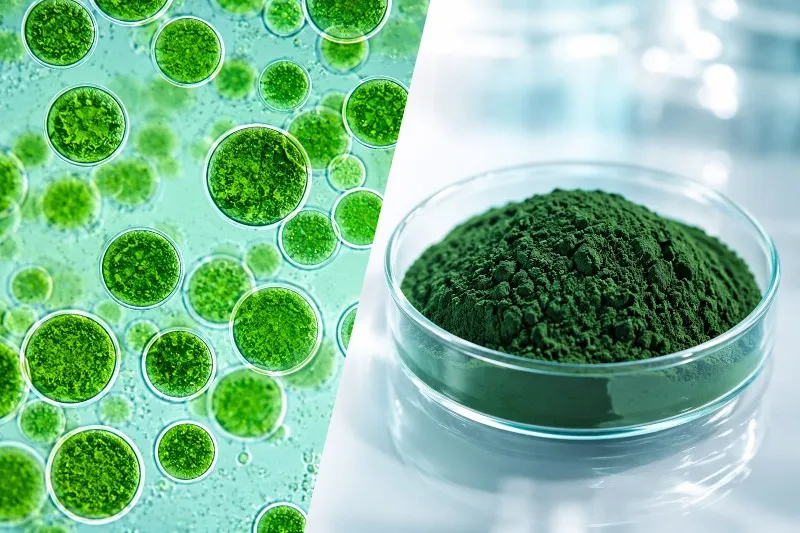
Chlorella (Chlorella vulgaris or Chlorella pyrenoidosa) is a genus of single-celled green microalgae that thrives in controlled freshwater environments. Unlike terrestrial crops, Chlorella requires specialized, highly technical aquaculture cultivation. Because Chlorella possesses a rigid, indigestible cellulose outer cell wall, it must undergo specialized mechanical or enzymatic broken cell wall technology during processing to ensure its dense internal nutrients are fully bioavailable to the human digestive tract. It represents a highly standardized, bio-secure microalgal technological ingredient.
Nutritional Comparison: Moringa vs. Chlorella
When developing a competitive supplement, raw nutritional metrics dictate label claims and regulatory compliance. The table below outlines the foundational nutritional profiles of both ingredients per 100 grams of dry powder.
| Nutrient Component | Moringa Powder | Chlorella Powder | Primary Supplement Benefit |
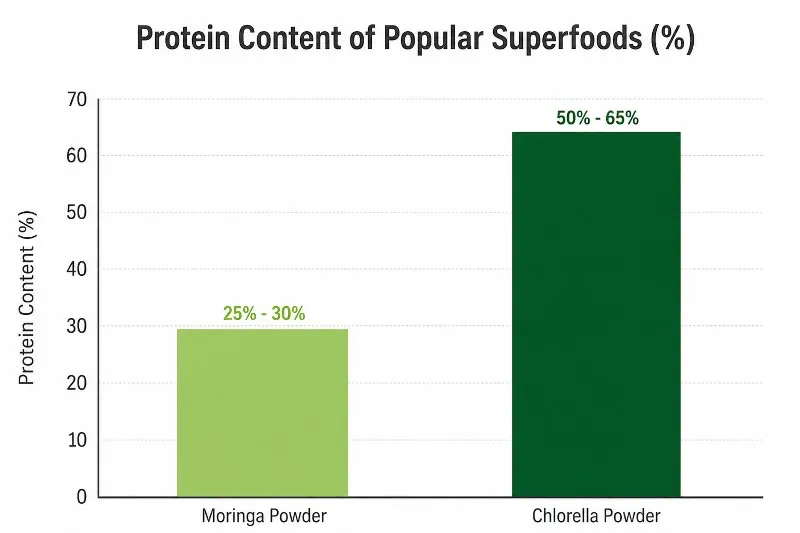
| Crude Protein | ★★★★☆ (25% - 30%) | ★★★★★ (50% - 65%) | Amino acid supply / Vegan protein claims |
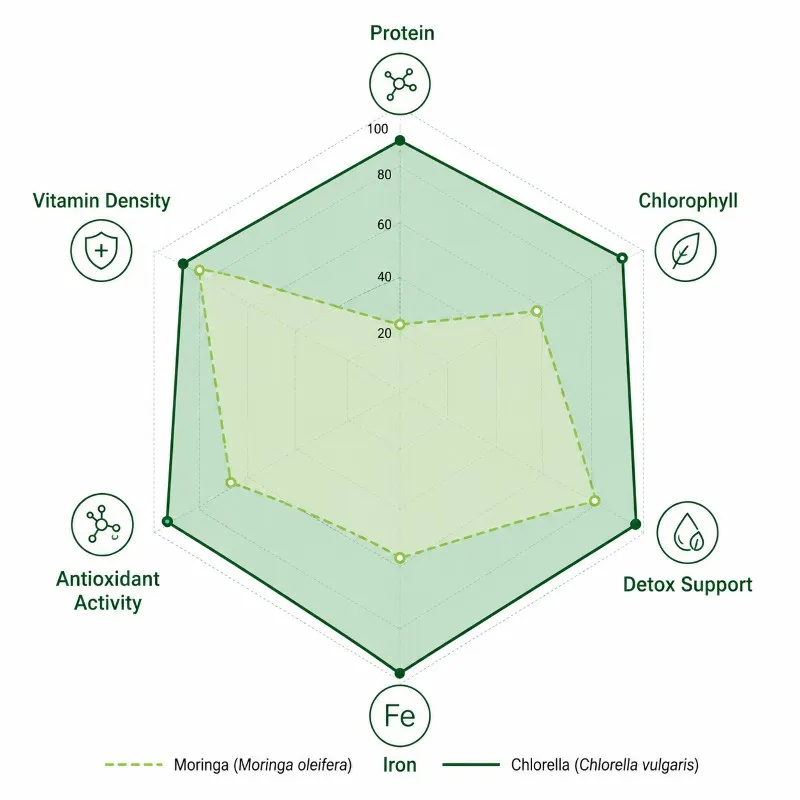
| Total Chlorophyll | ★★☆☆☆ (~0.7%) | ★★★★★ (2.0% - 3.5%) | Natural detoxification and cellular health |
| Total Iron | ★★★★☆ (~28 mg) | ★★★★★ (~130 mg) | Red blood cell support and oxygen transport |
| Vitamin B12 (Cobalamin) | None (0 mcg) | Present* (80 - 200 mcg) | Essential neurological support for vegans |
| Omega-3 Fatty Acids | Low (Alpha-Linolenic) | Moderate (EPA / ALA) | Cardiovascular and anti-inflammatory support |
| Antioxidants / Phenolics | High (Flavonoids) | High (Carotenoids) | Free radical scavenging and shelf stability |
| Bioavailability / Digestibility | Good (Standard Leaf) | Good (Requires Broken Wall) | Efficiency of nutrient absorption |
Protein Content of Popular Superfoods (%)
The starkest contrast between these two green ingredients lies in their macro-nutrient density, specifically their total crude protein content. While Moringa leaf powder delivers a respectable protein content, Chlorella matches or exceeds traditional concentrated protein sources, making it a highly efficient functional driver for modern formulations.
Health Benefits Comparison & Clinical Evidence
Both ingredients possess clear health benefits, but their mechanisms of action and biochemical profiles align them with entirely different product categories.
Benefits of Moringa
Moringa leaf powder is exceptionally rich in plant-based polyphenols, specifically quercetin and chlorogenic acid. It operates primarily as a broad-spectrum, whole-food multivitamin that supports systemic health, daily energy metabolism, and oxidative stress reduction [1]. Because it is a traditional botanical leaf, it appeals strongly to clean-label, heritage-driven holistic wellness brands focusing on general vitality and herbal traditional remedies.
Benefits of Chlorella
Chlorella is a biochemical powerhouse. Beyond its status as a complete vegan protein containing all nine essential amino acids, its primary functional value comes from two unique components:
- Unmatched Chlorophyll Density: Chlorella contains one of the highest concentrations of natural chlorophyll discovered in the plant kingdom. This high density allows it to bind specifically to heavy metals (such as methylmercury, lead, and cadmium) and persistent organic pollutants within the gastrointestinal tract, facilitating their safe excretion before systemic absorption occurs [2].
- Chlorella Growth Factor (CGF): Unique entirely to Chlorella, CGF is a water-soluble nucleotide-peptide complex containing DNA, RNA, amino acids, and vitamins. Clinical studies indicate that CGF actively accelerates cellular repair, enhances macrophage activity, and stimulates the proliferation of natural killer (NK) cells, providing a definitive, measurable boost to the human immune response [3].
Which Ingredient Has Stronger Market Demand?
From a commercial procurement and brand-positioning standpoint, tracking global market trajectories is vital for long-term inventory and formulation planning.According to comprehensive industry reports compiled by Grand View Research and Fortune Business Insights, the global superfoods market exceeded USD 180 Billion in 2024, maintaining a steady compound annual growth rate (CAGR) of approximately 6% to 8% [4, 5].
The Moringa ingredients market is projected to expand significantly, tracking toward a valuation exceeding USD 10 Billion by 2030 [5]. However, much of this massive volume is driven by agricultural raw biomass, oil extraction, and widespread low-cost food fortification across developing nations.
Conversely, the global Chlorella market, valued at approximately USD 250 million to USD 300 million, represents a highly specialized, higher-margin sector driven almost exclusively by the premium functional supplement, sports nutrition, and healthy aging industries in North America, Europe, and developed parts of the Asia-Pacific region [6]. Procurement managers value Chlorella because it commands higher retail price-points and attracts a highly loyal, health-conscious demographic willing to pay for verified technical specifications.
Supplement Applications: Which Is More Versatile?
From a formulation perspective, chlorella is generally easier to incorporate into a wider range of supplement products, making it a flexible option for manufacturers.While Moringa is highly effective in traditional herbal capsules, functional tea blends, and wellness powders, its distinct, sharp herbal taste profile can sometimes limit its inclusion rate in delicate food formulations.
Chlorella Powder, due to advanced processing methodologies that can yield subtle, neutral taste notes, integrates seamlessly into complex green superfood blends, heavy metal detox liquids, vegan protein isolates, sports nutrition recovery shakes, and advanced healthy aging products. Its physical characteristics-such as a highly uniform particle size distribution and optimal bulk density-ensure maximum compatibility during automated high-speed tablet pressing and hard-capsule filling procedures.
Moringa vs. Chlorella: Side-by-Side Summary
To simplify your raw material evaluation and procurement decisions, we have structured this direct operational matrix:
| If Your Product Formulation Requires... | The Scientifically Superior Choice Is... |
| Maximum Crude Protein & Amino Acid Efficiency | Chlorella (50% - 65% total content) |
| High Chlorophyll Density for Visual & Functional Claims | Chlorella (Yields 2% to 3.5% pure chlorophyll) |
| Traditional, Whole-Leaf Botanical Positioning | Moringa (Strong Ayurvedic heritage appeal) |
| Targeted Heavy Metal Detoxification Lines | Chlorella (Backed by verified binding affinity) |
| High-Performance Sports Nutrition & Recovery | Chlorella (Fueled by natural CGF cellular repair) |
| Comprehensive Vitamin B12 Profiles for Vegans | Chlorella (Contains bioavailable active B12) |
| Mass-Market Cost-Driven Agricultural Sourcing | Moringa (Extensive open-field farming availability) |
Why More Supplement Brands Are Choosing Chlorella
The global supplement landscape has experienced a profound shift. Historically, brands formulated general "Greens Powders" focused merely on basic vitamin matching. Today, the market has transitioned toward high-protein greens, and it is moving rapidly toward multi-functional superfoods that address multiple consumer demands simultaneously.
Modern consumers demand products that deliver verifiable clean-label attributes, rich plant proteins, concentrated antioxidants, and active cellular protection. Chlorella inherently satisfies all of these requirements within a single, unadulterated ingredient matrix. By integrating a singular, premium component like Chlorella into your formulation, you can streamline your bill of materials (BOM), minimize raw material testing costs, and present a clear, potent value proposition directly to the consumer.
Choosing a Reliable Organic Chlorella Powder Supplier
For commerical procurement managers and brand founders, the ultimate quality of your finished product relies entirely on the technical capabilities of your ingredient manufacturer. When auditing potential microalgae suppliers, we advise enforcing five strict quality control benchmarks:
- Rigorous Organic Certifications: Ensure the material carries fully traceable USDA Organic and EU Organic certifications, confirming that the aquaculture cultivation processes are completely free of synthetic chemical inputs.
- Validated Broken Cell Wall Technology: Request microscopic validation or cellular digestibility reports to confirm that the Chlorella cell walls have been effectively fractured without damaging the delicate internal proteins and CGF fractions.
- Strict Heavy Metal & Microbiological Testing: Microalgae are natural environmental binders. Your supplier must provide a comprehensive Certificate of Analysis (COA) for every single batch, proving heavy metal contents (such as lead, arsenic, cadmium, and mercury) sit safely below strict international regulatory thresholds.
- Enzymatic Processing and Purity Controls: Partner with manufacturers utilizing advanced, clean processing systems-such as specialized non-chemical methods-to retain maximal biological activity while eliminating industrial chemical residues.
- A Stable, Verifiable Supply Chain: Ensure your partner owns or directly controls their cultivation infrastructure to guarantee year-round price stability, consistent color grading, and long-term batch uniformity.
At Botanical Cube Inc., we leverage nearly twenty years of specialized research, development, and advanced industrial production experience to supply premium ingredients to global supplement brands. Our organic Chlorella powder is cultivated under highly controlled, pristine environmental conditions and undergoes rigorous physical broken cell wall processing to ensure optimal bioavailability and flawless performance in high-speed manufacturing environments.We provide comprehensive technical documentation, including up-to-date COAs, technical specification sheets, and regulatory compliance data tailored specifically to the strict standards required for entry into North American and European markets.
Choosing the Best Ingredient for Your Next Supplement
Both moringa and chlorella have earned their place in the growing superfood market, yet their strengths differ significantly.Moringa appeals to consumers seeking a familiar botanical ingredient with a broad spectrum of naturally occurring nutrients. Chlorella attracts interest for its concentrated nutritional profile and its role in modern functional nutrition products.
For manufacturers and brands, the decision should be guided by formulation goals, product format, target audience, and market demand. Understanding these differences can help create products that deliver both consumer value and long-term commercial potential.If you are currently developing a new formula or looking to upgrade an existing product line with a reliable, high-purity ingredient supply, our global procurement and R&D support teams are ready to assist you with tailored solutions and competitive bulk options.
For technical documentation, custom formulation consultations, or to request a complimentary product sample of our premium Organic Chlorella Powder, please reach out directly to our global sourcing team at sales@botanicalcube.com.
References
[1] Fahey, J. W. (2005). Moringa oleifera: A review of medical evidence for its nutritional, therapeutic, and prophylactic properties. Part 1. Trees for Life Journal, 1(5), 1-15.
[2] Merchant, R. E., Andre, C. A., & Sica, D. A. (2001). Nutritional supplementation with Chlorella pyrenoidosa for mild to moderate hypertension. Journal of Medicinal Food, 4(3), 141-149.
[3] National Institutes of Health (NIH) / PubMed Central. Clinical evaluations on the immunomodulatory effects of Chlorella vulgaris administration and CGF nucleotide allocation in healthy subjects. Journal of Dietary Supplements, Archive Database.
[4] Grand View Research. (2024). Superfoods Market Size, Share & Trends Analysis Report By Product, By Application, By Distribution Channel, By Region, And Segment Forecasts 2024 - 2030.
[5] Fortune Business Insights. (2024). The Global Moringa Ingredients Market Size, Growth, and Industry Analysis by Type, Application, and Regional Forecast 2024-2032.
[6] Mordor Intelligence. (2025). Chlorella Market - Size, Share, Trading Volume, and Growth Trends Analysis (2026 - 2031).