




When sourcing 🟢high-quality Matcha Powder, many buyers start by researching traditional origins and well-known producing regions such as Uji, Japan. However, for businesses purchasing Matcha Powder at a commercial scale, selecting the right supplier requires more than evaluating origin reputation. Factors such as production capability, quality consistency, compliance, and long-term supply stability are equally important.
In recent years, China has developed a growing Matcha Powder manufacturing industry, supported by improved cultivation practices, advanced processing technology, and large-scale production capabilities. Today, many international buyers work with China-based suppliers for bulk Matcha Powder used in beverages, food products, and dietary supplement applications.
However, suppliers in the China Matcha Powder market vary significantly in terms of quality control, manufacturing capability, testing standards, and supply reliability. Before selecting a supplier, buyers need to carefully evaluate factors such as raw material sourcing, production processes, certifications, batch consistency, and the supplier's ability to support long-term cooperation.
This guide provides a practical framework to help you evaluate a 🟢Matcha Powder supplier in China, compare different suppliers, reduce sourcing risks, and make a more informed purchasing decision.
1. Define Your Matcha Powder Requirements Before Selecting a Supplier
Before contacting any supplier, you must define exactly what your production line needs. If you do not specify your technical parameters upfront, you risk overpaying for ceremonial-grade powder when a high-quality culinary grade would perform better, or buying cheap powder that ruins your product's color.
1.1 What Application Will Your Matcha Powder Be Used For?
Matcha behaves differently depending on the matrix of your final product. For instance, the pH of a plant-based milk or the heat of a baking line will alter how Matcha dissolves and maintains its green hue.
| Application | Primary Sourcing Focus | Technical Requirement |
| Ready-to-Drink (RTD) Beverages | High solubility, color stability, low sedimentation | D50 particle size of 10-15 microns, low astringency |
| Food & Bakery (Cakes, Ice Cream) | Thermal stability, intense natural green color, strong flavor | Heat-resistant chlorophyll profile, culinary grade |
| Nutraceuticals & Supplements | Purity, high active compounds, heavy metal clearance | High L-theanine and EGCG content, organic certification |
| Bulk Distribution / Repackaging | Cost efficiency, shelf-life stability | Standardized moisture (<5.0%), robust barrier packaging |
1.2 Should You Choose Culinary Grade, Premium Grade, or Organic Matcha?
Many suppliers use vague terms like "AAA Grade" or "Premium Grade" to describe Matcha Powder quality. However, these labels alone do not provide enough information for evaluating product consistency and suitability. A more reliable approach is to examine the cultivation method, especially shade-growing practices, which directly influence important quality characteristics such as color, flavor, and amino acid content.
True Matcha must be shaded under black vinyl netting for at least 20 to 25 days before harvest [1]. Shading blocks 90% of sunlight, forcing the tea plant to produce massive amounts of chlorophyll and amino acids, particularly L-theanine. Under shading, L-theanine levels in the leaves typically rise from 0.8% to over 2.2% of dry weight, while bitter catechins decrease [1].
If a supplier offers "Matcha" at an unbelievably low price without shade-growing, they are simply selling common green tea powder, which is pale, highly bitter, and lacks the signature sweet-savory umami flavor.

2. Evaluate Whether a Matcha Supplier Is a Manufacturer or Trading Company
In China's tea industry, thousands of middle-tier trading companies list themselves as "factories." Working with a middleman increases your costs and introduces severe communication delays when technical adjustments are needed.
2.1 How to Verify a Matcha Powder Supplier's Manufacturing Capability?
To verify if a supplier is a genuine manufacturer, ask for specific operational documents and look for these signs:
✔ The Plantation Source:
Genuine manufacturers own or manage dedicated tea farms. Ask for the geographical coordinates of their agricultural base.
✔ Milling Infrastructure:
Ask if they use traditional ball-mill pulverizers or modern air-flow jet mills. Jet mills can process thousands of kilograms per hour while keeping the chamber cool, preserving the Matcha's color.
✔ Annual Capacity:
A real factory should have a steady annual output of at least 500 to 1,000 metric tons.
Case Study: How Botanical Cube Supports Reliable Matcha Powder Supply
When selecting a Matcha Powder supplier, many buyers focus on the sample they receive first. However, the bigger challenge often appears after bulk production begins - whether the supplier can maintain the same color, flavor, and quality consistency from one batch to another.
To address this challenge, Botanical Cube focuses on controlling the key factors that influence Matcha Powder quality, starting from the raw material stage. Instead of sourcing all tea leaves through open markets, we work with a dedicated plantation base where cultivation practices, agricultural inputs, and shade-growing conditions can be better managed.
During the manufacturing process, our production and R&D teams pay close attention to factors that affect the final Matcha Powder performance, including grinding conditions, particle size consistency, and heat control. Our low-temperature jet milling process is designed to reduce heat exposure during grinding and help maintain the natural green color and quality characteristics of the powder.
For international buyers, especially beverage, food, and supplement brands, supplier selection is not only about receiving a good sample. It is about finding a Matcha Powder manufacturer that can provide stable quality, reliable documentation, and consistent supply when production scales up.

2.2 What Information Should Buyers Request From a China Matcha Supplier?
Before moving forward with a supplier, buyers can use the following checklist to evaluate key qualifications and identify potential risks early:
[ ] Technical Data Sheet (TDS): Outlining moisture, mesh size, ash content, and microbiological limits.
[ ] Plantation Traceability: Documentation proving the raw tea leaves can be traced back to a specific harvest block.
[ ] Recent COA (Certificate of Analysis): Representing an actual production batch from the last 60 days.
[ ] Standard Lead Times: For both FCL (Full Container Load) and LCL (Less than Container Load) shipping.
3. Check Matcha Powder Quality Before Making a Purchase Decision
You cannot evaluate Matcha based on price sheets alone. You must analyze the physical, chemical, and biological markers of the powder.
3.1 Which Quality Indicators Matter When Buying Matcha Powder?
When reviewing a supplier's Certificate of Analysis (COA), pay close attention to these parameters:
| Quality Parameter | Target Standard / Range | Industrial Importance |
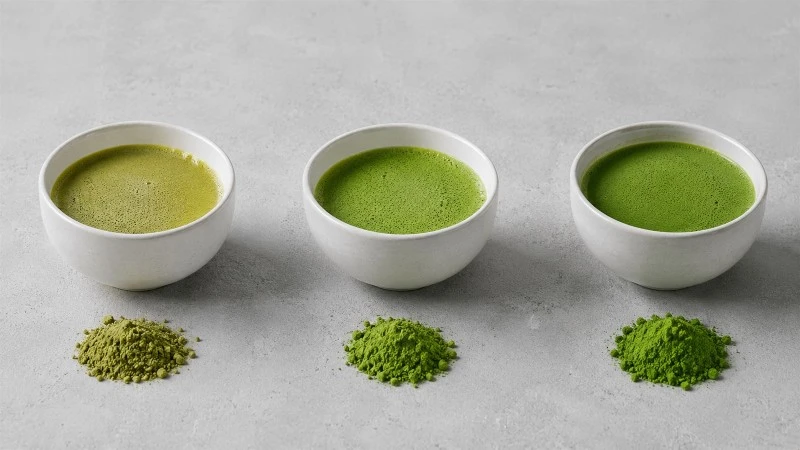
| Color | Vibrant jade green (no yellow/brown tints) | High chlorophyll content indicates proper shading. |
| Particle Size (D50) | 12 to 18 microns (800 - 1200 mesh) | Essential for mouthfeel and suspending the powder in liquids [2]. |
| Moisture Content | Less than 5.0% | Prevents clumping and mold growth during storage. |
| L-Theanine Content | Minimum 1.5% | Direct indicator of amino acid density and genuine Matcha quality. |
| Total Heavy Metals | Lead < 2.0 ppm, Arsenic < 1.0 ppm | Ensures compliance with strict international import limits [3]. |
3.2 Why Should Buyers Request Third-Party Testing Reports?
China's domestic testing standards sometimes differ from Western regulatory limits. For example, EU pesticide regulation EC 396/2005 sets highly restrictive Maximum Residue Limits (MRLs) for tea products, often testing for over 500 individual pesticide compounds [4].
Never rely solely on a supplier's internal lab testing. Always demand recent testing reports from internationally recognized third-party laboratories such as SGS, Eurofins, or Intertek.
At Botanical Cube, we run all our raw materials and finished powders through extensive testing sweeps. By matching our internal quality systems with third-party verification, we ensure our international buyers receive Matcha that is fully compliant with EU and US FDA import rules, containing zero banned residues or heavy metal overages.

4. Compare Matcha Suppliers Based on Total Purchasing Value, Not Only Price
The cheapest Matcha quote on your desk is often the most expensive one in the long run. If a batch of Matcha arrives at your facility with high yeast and mold counts, or if it turns brown in your RTD beverage bottles, you will face costly product recalls.
4.1 What Factors Affect Matcha Powder Pricing?
Matcha pricing in China is driven by three primary cost inputs:
✔ Harvest Season:
Spring-harvested tea contains the highest L-theanine and lowest bitterness, commanding the highest price. Summer and autumn harvests are cheaper but have a more astringent flavor and slightly yellower color.
✔ Milling Technology:
Standard ball-milling is slower but cheaper. Low-temperature jet-milling preserves chlorophyll but requires more electrical power and advanced machinery, adding a slight premium to the raw material cost.
✔ Organic Certification Compliance:
Organic Matcha requires strict soil management, natural fertilizers, and separate manufacturing runs, which adds roughly 20% to 30% to the base price.
5. Verify Certifications and Compliance Before Long-Term Cooperation
When selecting a Matcha Powder supplier, compliance is one of the key factors buyers should evaluate. Certifications, testing documents, and traceability records help companies assess whether a supplier can meet the requirements of their target markets.
5.1 Which Certifications Should Matcha Buyers Check?
Depending on your target consumer market, your supplier should hold and maintain the following verified certifications:
✔ Food Safety Management:
ISO 22000 or FSSC 22000.
✔ Dietary Compliance:
Kosher and Halal certifications.
✔Organic Markets:
USDA Organic (for North America) and EU Organic (for Europe). Ensure the supplier provides a valid Transaction Certificate (TC) for every single batch shipped.
5.2 How Can Buyers Reduce Supply Chain Risks When Importing From China?
To secure a highly stable, long-term supply chain:
✔ Request Retention Samples:
Ask the supplier to keep a physical sample of your approved batch in their archive. If a quality dispute arises later, both parties can test the identical retention sample.
✔ Verify Packaging Quality:
Pure Matcha is sensitive to light, oxygen, and moisture. Ensure your supplier ships in multi-layer aluminum foil bags, vacuum-sealed with nitrogen flushing, inside heavy-duty corrugated export cartons.
6. How to Request Samples and Evaluate a Matcha Supplier Before Bulk Ordering
The final step before placing a purchase order is evaluating physical product samples.
When you receive a 50g or 100g trial sample, do not just look at it in the bag. Put it through a rigorous benchtop test:
✔ Sift and Dry-Assess:
Sift 5 grams of the powder onto a white sheet of paper. Observe the color under natural daylight. Is it a vibrant green, or does it have yellow or gray tones?
✔ Evaluate Rehydration and Aroma:
Whisk the powder with hot water (80°C). Note if the aroma is fresh, grassy, and sweet, or if it smells flat or excessively roasted.
✔ Perform a Temperature Stability Test:
If you are using the Matcha in a beverage or baked product, prepare a small trial batch and expose it to your standard pasteurization or baking temperatures. Observe how long the green color holds before shifting toward brown.
The Sourcing Auditor's Checklist
Use this quick scorecard to compare and rate potential Chinese Matcha suppliers:
| Audit Parameter | Red Flag (Avoid) | Standard (Acceptable) | Elite (Preferred) |
| Traceability | Cannot prove farm source | Knows the region, buy from third parties | Direct owner of private plantation base |
| Shading Control | No shading, open-field green tea | 10 to 14 days partial shading | 20+ days strict shade-growing |
| Milling Method | High-temperature mechanical milling | Standard ball milling | Low-temperature jet milling ($D_{50}$ <15μm) |
| Chemical Safety | No pesticide reports available | Domestic self-test reports only | Recent third-party (Eurofins/SGS) pesticide clearing |
| Packaging | Common plastic bags, no vacuum | Sealed aluminum bags | Multi-layer aluminum foil with nitrogen flushing |
Ready to Evaluate Your Matcha Powder Options?
Before placing a bulk order, it is important to confirm that the supplier can meet your requirements for quality, documentation, and application performance.You can request Matcha Powder specifications, COA documents, testing information, and samples to compare product suitability before making a final sourcing decision.For customized requirements or further product information, contact Botanical Cube at 🟢sales@botanicalcube.com.

References
[1] Ku, K. M., et al. (2018). Shading effects on secondary metabolites and sensory attributes of green tea (Camellia sinensis L.). Journal of Agricultural and Food Chemistry, 66(12), 3012-3021.
[2] Sawamura, H., et al. (2020). Influence of particle size distribution on the physical and sensory properties of Matcha. Food Science and Technology Research, 26(3), 345-352.
[3] World Health Organization (WHO). (2021). Guidelines on established limits for heavy metals in herbal materials and agricultural food products. Geneva: WHO Press.
[4] European Commission. (2005). Regulation (EC) No 396/2005 of the European Parliament and of the Council on maximum residue levels of pesticides in or on food and feed of plant and animal origin. Official Journal of the European Union.