

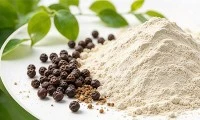

Can regular black pepper powder replace black pepper extract in dietary supplements or functional foods? While both ingredients come from Piper nigrum L., choosing between them involves more than comparing their prices.The key difference lies in their composition, piperine concentration, and suitability for specific formulations. Black pepper powder contains a broad spectrum of naturally occurring constituents in the pepper fruit, whereas black pepper extract is processed to achieve a specified concentration of target compounds, such as piperine.
For supplement brands, product developers, and ingredient buyers, this difference can influence dosage calculations, formulation consistency, quality control, and the cost per serving. A lower price per kilogram does not necessarily mean a lower formulation cost, especially when the target piperine content must be maintained.In this guide, we break down the differences between black pepper powder and black pepper extract, compare their applications, and explain which specifications, quality tests, and supplier requirements matter most when sourcing these ingredients for commercial production.

1. Is Black Pepper Extract the Same as Black Pepper?
Let's clear up the confusion right at the starting line. No, black pepper and black pepper extract are not the same thing commercially, functionally, or chemically.
What Is the Difference Between Whole Pepper, Powder, Extract, and Piperine?
To understand why they cannot be swapped out at a whim, we have to look at what happens to the raw botanical material during processing:
- Whole Black Pepper & Ground Black Pepper: This is the whole berry (Piper nigrum L.) either dried or mechanically ground down. Its primary components are crude fiber, starch, fixed oils, volatile aromatic oils (which give it that distinct pepper smell and taste), and a relatively low baseline of active alkaloids-typically containing only 2% to 5% piperine [1].
- Black Pepper Extract: This is a standardized intermediate or finished ingredient derived from the fruit through solvent extraction and purification. Through processing, most of the starch, fiber, and heavy aromatic oils are stripped away, concentrating the active compound-piperine-to standardized levels, commonly ranging from 10% up to 98% [2].
- Pure Piperine: Chemically isolated alkaloid crystals, often reaching purities of 98% to 99% through recrystallization, used primarily in high-end pharmaceutical or specialized nutraceutical delivery systems.

Why Are They Not Interchangeable?
Even though they share the same botanical lineage, their chemical profiles create entirely different engineering and commercial realities:
- Active Concentration: To get 10 milligrams of active piperine, you would need to consume roughly 250 to 500 grams of raw black pepper powder. In a formulation context, that amount of whole powder would overwhelm your capsule volume and burn your consumers' throats.
- Matrix and Sensory Impact: Raw powder brings intense flavor, dark color, and insoluble plant fibers. Standardized extracts, particularly high-purity grades, minimize flavor interference and focus entirely on the physiological mechanism of action-primarily acting as a bioavailability enhancer (e.g., boosting the absorption of companion nutrients like curcumin or coenzyme Q10 by inhibiting glucuronidation enzymes in the gut) [3].
Raw Black Pepper Powder vs. 95% Piperine Extract Comparison
| Feature | Regular Black Pepper Powder | 95% Piperine Standardized Extract |
| Active Ingredient (Piperine) | Low (approx. 2% – 5%) [1] | High & Standardized (95% min) [2] |
| Primary Function | Flavor, aroma, spice profile, dietary fiber | Bioavailability enhancement, targeted alkaloid delivery [3] |
| Sensory Impact | Strong pungent taste, dark color, distinct aroma | Neutral to slightly bitter (high purity), off-white powder |
| Inclusion Rate per Serving | 200 mg – 2,000+ mg (Bulk volume needed) | 5 mg – 10 mg (Ultra-low inclusion) |
| Ideal Application | Culinary blends, food seasonings, flavoring | High-potency dietary supplements, capsules, tablets |
2. Which Ingredient Should You Buy for Your Finished Product?
Deciding between raw powder, oleoresin, or a standardized extract depends entirely on your end product's application and commercial goals.
- When to choose Regular Black Pepper Powder: Use this when your product is positioned as a food seasoning, a culinary spice blend, or an ethnic food product where consumers expect authentic pepper flavor, aroma, and natural visual specks.
- When to choose Standardized Black Pepper Extract: Choose this when developing dietary supplements, capsules, tablets, or functional nutrition formulas where precise dosing of piperine is required to enhance nutrient absorption without adding unwanted spice flavor or bulk volume.
- When to choose Black Pepper Oleoresin: If your goal is to impart an authentic, liquid-phase spice flavor profile into sauces, beverages, or savory snacks without solid particles, an oil-soluble oleoresin extracted via supercritical fluid or solvent extraction is usually a better fit than a solid powder extract [4].
3. What Piperine Specification Do You Actually Need?
Once you determine that your formulation requires an extract, you will face a range of specifications: 5%, 10%, 95%, and 98% piperine.
Breaking Down the Numbers
Higher numbers do not automatically make a product "better"-they simply mean a higher concentration of the active alkaloid.
- Low-Content Extracts (5%–10%): Often used in functional foods, herbal blends, or animal nutrition where a mild matrix is preferred and exact pharmaceutical precision is secondary.
- High-Content Extracts (95%–98%): The industry standard for high-potency dietary supplement capsules and tablets (such as thermogenic fat burners or curcumin absorption boosters).
The Real Cost Equation: Price per Kilogram vs. Cost per Unit of Piperine
A common rookie mistake in procurement is buying the cheapest powder per kilogram. Let's look at a practical purchasing model.Suppose Supplier A offers a 5% Piperine extract at $15 per kilogram, while Supplier B offers a 95% Piperine extract at $90 per kilogram.
To deliver a target dose of 10 mg of active piperine per serving:
- Using Supplier A (5%): You need 10mg / 0.05 = 200mg of raw extract per capsule. One kilogram gives you 5,000 servings. Raw material cost per serving =$15 / 5000 = $0.0030
- Using Supplier B (95%): You need 10mg/ 0.95≈10.53mg of raw extract per capsule. One kilogram gives you roughly 94,967 servings. Raw material cost per serving =$90 / 94967 ≈ $0.0009$ [5].
Cost-in-Use Comparison: 5% vs. 95% Piperine Extract
| Evaluation Parameter | Supplier A (5% Piperine Extract) | Supplier B (95% Piperine Extract) |
| Quoted Price per Kilogram | $15.00 / kg | $90.00 / kg |
| Target Piperine per Serving | 10 mg | 10 mg |
| Required Raw Material per Serving | 200 mg (10mg} / 0.05) | 10.53 mg (10mg/ 0.95) [5] |
| Servings Yield per 1 kg | 5,000 servings | ~94,967 servings |
| Raw Material Cost per Serving | $0.0030 | $0.0009 [5] |
* Despite the much higher upfront price tag per kilogram, the 95% extract drastically lowers your active cost per unit, while saving massive amounts of capsule space.
4. What Should Buyers Check Before Approving a Supplier?
A low price or a shiny product brochure means nothing if your shipment gets stuck at customs or fails incoming quality control (QC). Before approving a black pepper extract supplier, your QA team needs to look past the sales pitch and inspect the hard technical documentation.
Verifying the Certificate of Analysis (COA) and HPLC Data
Never accept a generic product sheet. Always request a batch-specific COA that outlines:
- Assay Method: Ensure the piperine content is tested using High-Performance Liquid Chromatography (HPLC), which is the gold standard for accurate alkaloid quantification, rather than older, less reliable titration methods [6].
- Heavy Metals and Microbiology: Verify that lead, cadmium, arsenic, mercury, total plate count, yeast, mold, and E. coli fall well within your destination market's safety limits (e.g., USP or EU pharmacopoeia standards).
- Solvent Residues: Because extraction typically involves solvents (like ethanol or ethyl acetate), check the residual solvent section to ensure compliance with ICH guidelines. Furthermore, ask for pest management records confirming freedom from restricted fumigants like Ethylene Oxide (EtO) [7].
5. Can Black Pepper Extract Be Used in Your Existing Formulation Without Reformulation?
Switching from a whole spice powder to a 95% concentrated extract is not a simple "plug-and-play" operation. Your R&D and manufacturing teams must account for physical behavior:
- Bulk Density and Blend Uniformity: When a single capsule requires only 5 to 10 milligrams of a 95% extract, achieving uniform mixing across a multi-kilogram powder batch is difficult. Look for manufacturers offering micronized grades (typically 80 to 100 mesh) to prevent segregation and ensure blend homogeneity [8].
- Solubility Realities: Standard piperine extracts have poor water solubility. If you are developing a clear functional beverage, asking for a standard hydrophobic extract will result in floating particles and heavy sedimentation. You must verify whether your application requires specialized water-dispersible or emulsion-compatible grades.
6. How Should You Compare Quotes and Total Sourcing Costs?
When comparing quotes from different manufacturers, avoid looking at the per-kilo price in isolation. Build a comprehensive cost comparison matrix that accounts for:
- Effective Active Cost: The true price per gram of active piperine based on assay results.
- Minimum Order Quantities (MOQ): Standard trial batches usually start around 25 kg, whereas commercial production runs often unlock tier pricing.
- Documentation & Testing Overhead: Factor in whether the supplier provides complete, trustworthy third-party lab verification (such as Eurofins or SGS testing reports) or if you will incur independent testing fees upon arrival [9].
7. Where Can Buyers Source Reliable Black Pepper Extract?
When you have aligned your internal R&D, compliance, and procurement requirements, partnering with an experienced manufacturer makes all the difference.For buyers seeking reliable, batch-to-batch consistent extracts backed by complete technical files, Botanical Cube Inc. provides standardized black pepper extract options ranging from standard grades to high-purity 95%–98% Piperine. Our extraction facilities operate under strict quality management protocols, ensuring that every commercial batch is validated via robust HPLC testing, complete with residue tracking and customizable particle sizing to fit your specific capsule, tablet, or powder blending lines.
If you are currently evaluating formulations or scaling up production, you can request batch-specific COAs, technical data sheets, and complimentary laboratory-scale evaluation samples directly through our team.Ready to evaluate specifications for your next formulation? Reach out to Botanical Cube Inc. at sales@botanicalcube.com to request a customized quote, technical documentation, or trial samples tailored to your target application.
8. Frequently Asked Questions
Q: Is black pepper extract stronger than regular black pepper?
A: Yes, in terms of active piperine concentration. A 95% extract is roughly 20 to 45 times more concentrated in active alkaloids than natural whole pepper powder.
Q: Is 95% piperine considered pure piperine?
A: Not strictly. While 95% indicates a high concentration of the active alkaloid isolated from the botanical matrix, 98% to 99% is generally classified as high-purity isolated analytical grade piperine.
Q: Can black pepper powder directly replace extract in dietary supplements?
A: Generally no, unless your capsule size can accommodate massive volume increases and your formula can withstand strong spice flavors and dark coloration.
Q: What documents should I request with my bulk order?
A: Always secure a batch-specific COA (via HPLC), Material Safety Data Sheet (MSDS), Allergen Statement, Non-GMO statement, and residual solvent analysis.
References
[1] ISO 959-1:2005 - Black pepper and white pepper, whole or ground - Specifications. International Organization for Standardization.
[2] 2024 Industry Benchmark Report on Botanical Extract Standardization, Nutraceutical Business Review.
[3] Atal, C. K., et al. (1985). "Scientific basis for the therapeutic use of black pepper as a bioavailability enhancer." Journal of Ethnopharmacology, 13(2), 229-245.
[4] Salzer, U. J. (1975). "The analysis of pepper: Methods and problems." Flavour Industry, 6(4), 206-210.
[5] Internal B2B Sourcing Economics Case Study, Botanical Cube Inc. Processing Data (2025).
[6] AOAC Official Method 997.05 - Piperine in Black and White Peppers. Association of Official Analytical Chemists.
[7] European Commission Regulation (EC) No 396/2005 on maximum residue levels of pesticides in or on food and feed of plant and origin.
[8] Aulton, M. E. (2007). Pharmaceutics: The Science of Dosage Form Design. Churchill Livingstone, Edinburgh.
[9] SGS / Eurofins Global Food and Nutraceutical Testing Protocols for Botanical Raw Materials (2024-2026 Guidelines).