

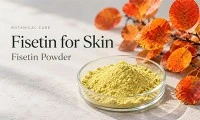
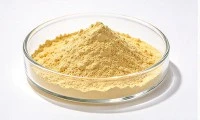
If you're consideringfisetin for a skincare or oral beauty product, you probably want to know two things: what it can do for skin, and whether it will work in the product you have in mind.As a fisetin powder manufacturer, I think both deserve a clear answer. The research is worth a look, but it doesn't tell you everything you need to choose a raw material. You still need to consider the formula, the specification, and the testing needed before production.So let's start with what the studies actually show about fisetin and skin. Then we can look at what those findings mean for your product and what to check before ordering.
1. What Does the Skin Research Show?
Before we talk about specifications or pricing, we need to answer the most fundamental question: what does fisetin actually do for the skin in a lab setting, and does that translate into something your customers can actually experience?
In laboratory and animal studies, fisetin acts primarily as a targeted antioxidant and a senolytic agent [1]. When skin cells are exposed to chronic UV radiation or environmental stress, some of them stop dividing and turn into "zombie" or senescent cells. These cells hang around and secrete inflammatory compounds known as SASP (senescence-associated secretory phenotype), which break down surrounding collagen and elastin. Fisetin has shown a strong ability in preclinical models to clear out these damaged cells and suppress matrix metalloproteinases like MMP-1, which are responsible for collagen degradation [1].
At the same time, researchers have explored its multi-target benefits, noting that it helps inhibit advanced glycation end-products (AGEs) and provides mild soothing support against UV-induced erythema [2].
Table 1: Fisetin Skin Research Evidence Mapping
| Target Skin Benefit | Study Model & Material Used | Key Biomarkers / Metrics Measured | Evidence Status for R&D Decision |
| Senolytic & Collagen Protection | Dermal Fibroblasts / Hairless Mice [1] | MMP-1 suppression, SASP inflammatory reduction | Strongly supported in Preclinical models; Requires delivery verification in finished base. |
| UV-Induced Photoaging Defense | UVB Irradiation Mouse Models [2] | Epidermal thickness, ROS radical scavenging | High relevance for post-sun & daily defense formulas. |
| Anti-Glycation & Brightening | In vitro Enzyme Assays [1, 2] | AGE formation inhibition, Tyrosinase activity | Moderate support; Best combined with synergistic actives. |
The Catch for Buyers:
The biggest trap in raw material sourcing is assuming that a positive cell culture study means your finished face cream will magically erase wrinkles. Most of the glowing data comes from in vitro cell assays or animal models using topical applications with specialized carrier systems [1, 2]. As a product developer, you have to look past the abstract.
Ask yourself:
are you building a premium anti-aging serum where you can invest in proper delivery technology, or are you looking for a simple marketing checkbox? If you want real efficacy, you need to match the research model's delivery method in your own formula, rather than just dusting a standard powder into a basic cream base and hoping for the best.
2. Fisetin in Skincare and Oral Beauty Products
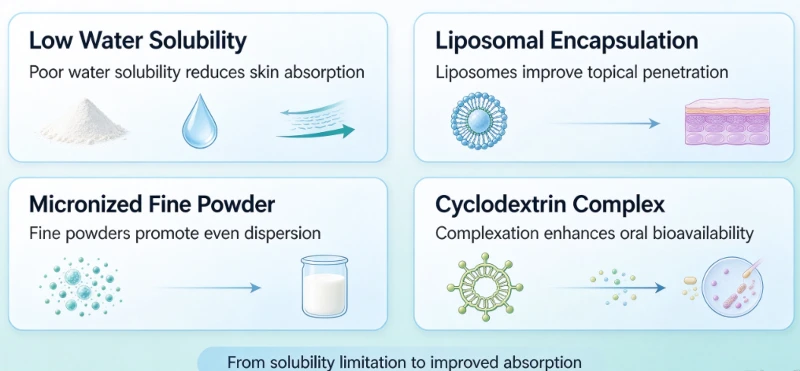
Once you decide the science is worth pursuing, your formulation team will immediately hit the biggest operational hurdle: fisetin is notoriously hydrophobic. It has terrible water solubility, which drives formulators crazy.
If you are developing a topical skincare product like a serum, lotion, or facial oil, raw fisetin powder will not magically dissolve in water-heavy bases. Without proper solvents, co-solvents (like butanediol or ethoxydiglycol), or advanced delivery systems such as liposomes and cyclodextrin inclusion complexes, the powder will simply aggregate, settle to the bottom of your batch, or crystallize out on the skin surface.
If your company leans toward the ingestible beauty (nutricosmetics) market, the challenge shifts from skin penetration to oral bioavailability. Standard fisetin has low systemic absorption, meaning a huge percentage passes right through the body without reaching dermal tissues.
Visual Diagram: Formulation Carrier System vs. Bioavailability
How to Make the Call:
Take a hard look at your current lab capabilities. If your team does not have experience working with liposomal encapsulation or specialized oil-phase dispersion, buying cheap 98% raw powder will lead to a failed batch. Always ask your supplier if they offer micronized grades or pre-solubilized carrier solutions that save your lab weeks of trial and error.
3. Safety, Regulations, and Product Claims
Claims such as "reverses skin aging" or "repairs cellular damage" may sound appealing, but I would be careful about using them on a product label. Before choosing the wording, I recommend checking the requirements in your target market and whether the evidence supports the claim for your finished product.
Fisetin derived from natural sources like smoke tree extract (Cotinus coggygria) or produced via chemical synthesis has distinct regulatory paper trails. You must verify whether the specific ingredient identity is fully compliant with your target export markets. More importantly, you need to draw a thick red line between a research observation and a marketing claim. You cannot take a study showing that fisetin reduced UV-induced skin damage in mice and write "protects against sunburn with SPF 50" on your packaging.
| Region / Market | Primary Compliance Route | Acceptable Claim Direction | Prohibited Claim Pitfalls |
| USA (FDA) | Topical Cosmetic / Dietary Supplement (NDI) | "Antioxidant protection", "Supports skin elasticity" | "Reverses cellular damage", "Treats skin inflammation" |
| EU (CPNP) | Cosmetic Ingredient Catalogue / Novel Food | "Protects against oxidative stress", "Skin conditioning" | Medical/Therapeutic anti-aging claims |
| Global Export | International Material Safety Data Sheet (MSDS) | "Daily environmental defense" | Direct SPF/Sunblock claims without clinical trial |
The Golden Rule for Sourcing:
Never assume that a supplier's safety data sheet (SDS) or a general cosmetic directory listing gives you a free pass to make wild anti-aging claims. Align your marketing team with your regulatory counsel early, and keep your claims centered on antioxidant support, barrier protection, and skin vitality.
4. Selecting the Right Specification: 98% Pure vs. Botanical Extracts
When you open a supplier catalog, you will usually see a few different options: low-percentage herbal extracts (like 10% or 50% flavonoid blends) versus high-purity isolated powders (typically 98% HPLC test results).
How do you choose? It comes down to your product positioning and delivery format.
- High-purity 98% fisetin is ideal for precision formulas, clear serums, and high-end capsules where you need exact active loading and minimal interference from plant pigments.
- On the flip side, lower-purity botanical extracts from Cotinus coggygria often retain a wider spectrum of natural co-compounds, but they can introduce unwanted brownish discoloration and herbal odors that ruin a pristine white face cream or a clear gel serum.
Table 3: Specification Comparison Matrix
| Specification | Physical Appearance | Application Suitability | Key Commercial Trade-offs |
| Fisetin 98% HPLC | Fine Yellow Powder | High-potency serums, Nutricosmetic capsules, Liposomes | Higher raw material cost, requires solubilization design. |
| Fisetin 50% Extract | Brownish Yellow Powder | Herbal skincare, Anti-aging cream bases | Lower cost, but introduces natural plant color/odor. |
| Fisetin 10% Water-Dispersible | Light Yellow Powder | Functional beverages, Facial mist serums | Easy processing, lower active loading per gram. |
What to Check on the COA:
When your sales rep sends over the Certificate of Analysis (COA), do not just look at the big "98%" number at the top. Look closely at the testing method (HPLC is standard), check the residual solvents (make sure they used safe extraction solvents like ethanol rather than harsh industrial chemicals like benzene), and verify heavy metal and microbial limits.
5. Moving from Sample to Pilot Batch: What Your QA Team Needs
You found a supplier, you got a quote, and the sample is sitting on your desk. Now what? Before you sign off on a commercial purchase order, your QA team needs to put that sample through a strict validation checklist.
- Identity & Purity Check: Send a small split of the sample to an independent third-party lab (like SGS or Eurofins) to run an HPLC identity verification. Never rely solely on the supplier's in-house paperwork for your first commercial run.
- Matrix Compatibility Test: Have your formulator drop the sample into your actual base formula. Does it change the color over 48 hours? Does it precipitate out when exposed to standard room temperatures or accelerated heat tests (40°C)?
- Batch-to-Batch Consistency: Ask the supplier for COAs from three distinct manufacturing batches, not just the best lab sample they have in stock. Consistency in color and particle size is the hallmark of a reliable extraction facility.

Need Fisetin Powder or OEM Support?
If you're considering fisetin for a new product, feel free to tell us what you have in mind. You may already have a specification, or you may still be deciding which material to test. Either way, we can start there.
At Botanical Cube, we offer 10%, 50%, and 98% HPLC fisetin powder. We can share specifications and relevant batch documents, discuss pricing, and arrange samples for your evaluation. If you're looking for OEM support, we can also discuss capsule, tablet, or powder blend options, along with your formula and packaging requirements.
Email us at sales@botanicalcube.com with a few details about your product and where you plan to sell it. If you have an estimated quantity, include that too-it will help us put together a more useful reply.
References
[1] Maher, P. (2021). "The potential of fisetin for the treatment of age-related neurological and skin diseases." Biochemical Pharmacology, 185, 114439. (Covers cellular senolysis, antioxidant mechanisms, and MMP reduction in dermal models).
[2] Kim, H. et al. (2017). "Fisetin protects against UVB-induced photoaging in human skin fibroblasts and hairless mice." Nutrients, 9(9), 984. (References experimental photoprotection and collagen preservation data).